Skip to content
Trending
August 17, 2025As Trump berates Goldman, other economists agree that higher tariff inflation is coming November 27, 2025Private payroll losses accelerated in the past four weeks, ADP reports September 19, 2025FedEx stock rises on better-than-expected earnings August 18, 2025Modi gives tax boon to India’s economy amid Trump tariff tensions July 19, 2025Abbott stock fell victim to an old earnings season truth: It’s all about the guidance October 21, 2025This week’s critical inflation report comes with a variety of doubts about the data August 5, 2025Trump says JPMorgan Chase, Bank of America rejected him as a customer May 9, 2025Germany’s new economy boss has a plan — and it starts with risk, speed and big bets April 12, 2025GM cutting jobs, idling Canadian electric van plant due to ‘market demand’ August 21, 2025July home sales rise as prices approach inflection point
  Monday 8 June 2026
everydayread.net
  • HOME
  • Bitcoin
  • Business
  • Earnings
  • Economy
  • Finance
everydayread.net
everydayread.net
  • HOME
  • Bitcoin
  • Business
  • Earnings
  • Economy
  • Finance
everydayread.net
  Finance  Stock volatility poses an ‘opportunity,’ investment analyst says. Here’s why
Finance

Stock volatility poses an ‘opportunity,’ investment analyst says. Here’s why

AdminAdmin—March 22, 20250

Traders work on the floor of the New York Stock Exchange (NYSE) in New York City. 

Spencer Platt | Getty Images

Stock market corrections are common

First, there is some consolation for investors. Though they may feel painful, stock market corrections are fairly common.

There have been 27 market corrections since November 1974, including last week’s market move, according to Mark Riepe, head of the Schwab Center for Financial Research. That amounts to roughly one every two years or so, on average.

Most of them haven’t cascaded into something more sinister. Just six of those corrections became “bear markets” (in 1980, 1987, 2000, 2007, 2020 and 2022), according to Riepe. A bear market is a downturn of 20% or more.

Pullbacks can be ‘an incredible opportunity’

More stories

Wholesale egg prices have ‘plunged,’ analyst says — shoppers may soon see some relief

March 18, 2025

Watch: Senate Banking Committee holds confirmation hearing for Trump Fed nominee Miran

September 4, 2025

Wall Street bets on chip boom are getting more concentrated, and it could be good thing for investors

September 19, 2025

What the Discover merger approval means for Capital One and 2 other financials

April 22, 2025

Investors often engage in catastrophic thinking when there’s a market pullback, believing the market may never recover and that they’ll lose all their hard-earned money, said Brad Klontz, a certified financial planner and behavioral finance expert.

In reality, pullbacks are a less-risky time to invest, relative to when stocks are hitting all-time highs and feel more “exciting,” said Klontz, managing principal of YMW Advisors in Boulder, Colorado, and a member of CNBC’s Advisor Council.
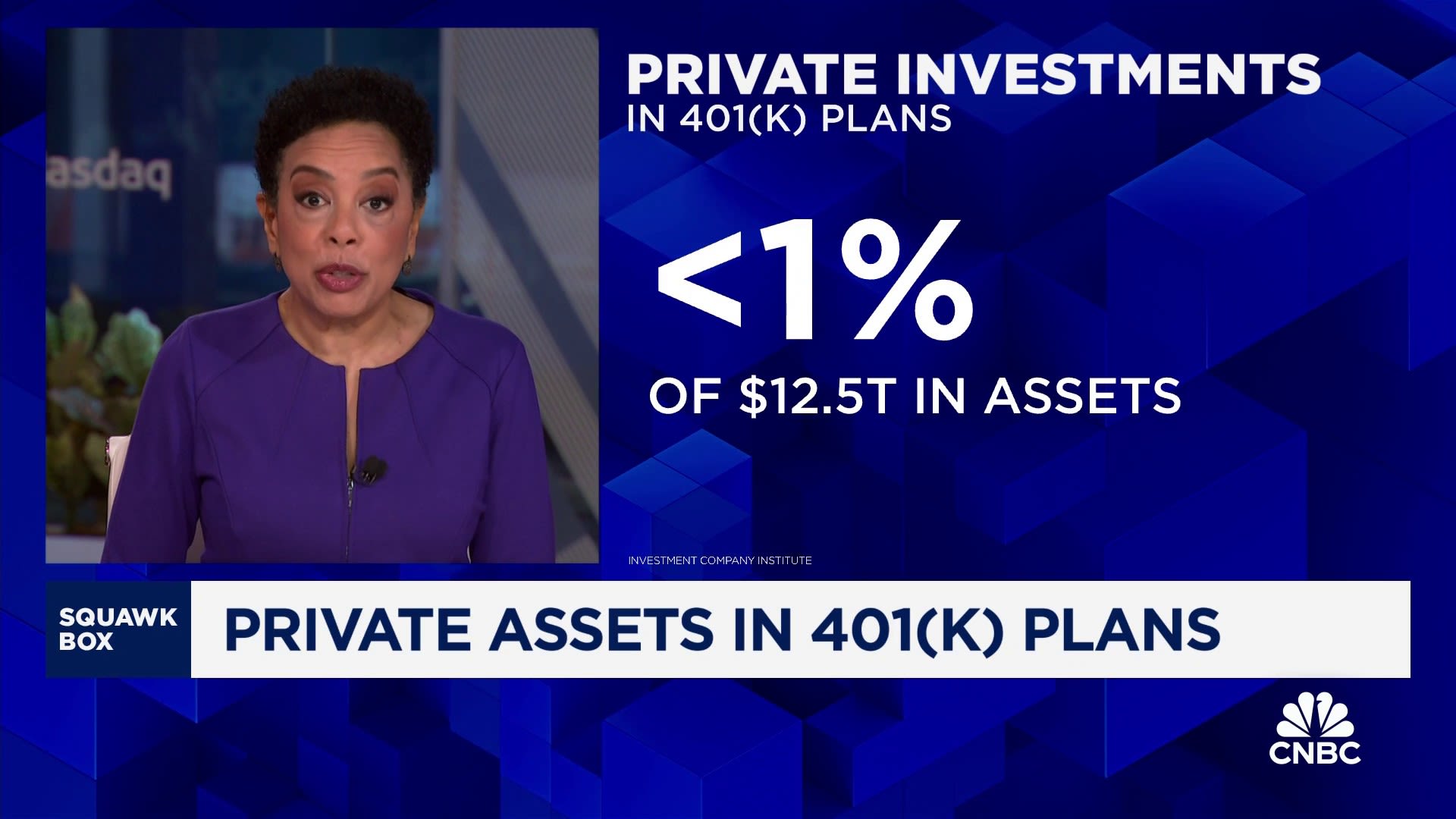
Private assets in 401(k) plans: Here's what to know

Investors are also buying stocks at a discount, known as “buying the dip.”

“It’s an incredible opportunity for you to be putting more money in,” Klontz said.

This is especially the case for young investors, who have decades for stock prices to recover and grow, Klontz said.  

Investors in workplace plans like 401(k) plans unconsciously take advantage of stock selloffs via dollar-cost averaging. A piece of their paycheck goes into the market every pay cycle, regardless of what’s happening in the market, Klontz said.

Be mindful of stock/bond allocations

However, investors should think carefully before going on a stock-buying spree, said Christine Benz, director of personal finance and retirement planning for Morningstar.

They should generally avoid diverging from their stock/bond allocations calibrated in a well-laid financial plan, she said.  

Of course, certain investors with cash on the sidelines may be able to take advantage of selloffs by investing in undervalued stocks, Benz said. U.S. large-cap stocks, for example, were selling at a roughly 5% discount relative to their fair market value as of Wednesday, according to Morningstar.

“I would let the asset-allocation target lead the way in determining whether that’s an appropriate strategy,” Benz said.

Chicago Fed President Goolsbee sees rate cuts depending on inflation progress
Take a look inside French luxury retailer Printemps’ first U.S. store
Related posts
  • Related posts
  • More from author
Finance

Visa says new AI shopping tool has helped customers with hundreds of transactions

December 18, 20250
Finance

Billionaire fund manager Ron Baron praises beaten-up financial stock whose new CEO he compares to Jamie Dimon

December 17, 20250
Finance

Nasdaq moves to make trading nearly 24 hours. Why some on Wall Street say that’s a bad idea

December 16, 20250
Load more
Read also
Earnings

Google cloud growth tops Microsoft and Amazon as all three beat estimates on AI demand

May 2, 20260
Finance

Visa says new AI shopping tool has helped customers with hundreds of transactions

December 18, 20250
Economy

Trust these numbers? Economists see a lot of flaws in delayed CPI report showing downward inflation

December 18, 20250
Earnings

Nike tops earnings estimates but shares fall as China sales plunge, tariffs hit profits

December 18, 20250
Business

American Airlines no longer lets basic economy flyers earn miles

December 18, 20250
Finance

Billionaire fund manager Ron Baron praises beaten-up financial stock whose new CEO he compares to Jamie Dimon

December 17, 20250
Load more
    © 2022, All Rights Reserved.
    • About Us
    • Advertise With Us
    • Contact Us
    • Disclaimer
    • Cookie Law
    • Privacy Policy
    • Terms & Conditions