Retirees and investors near retirement are in a tough spot. They need growth from their stock market portfolio to fight inflation and rising health care costs, but another major market drop could leave stocks in a “lost period” which they don’t have the time to wait out.
As a general rule in the current investment era, many financial firms tell recent retirees to keep more than half of their portfolio in stocks and then dial it down as they get older. Once upon a time, a 65 year-old with 50% in stocks would have been seen as aggressive. But with a record concentration of the U.S. stock market in a handful of big tech stocks — roughly a third of the S&P 500 — concerns about an AI bubble and major market correction are warranted.
According to research from Harvard economist Jason Furman, a former Obama White House advisor, chip sales represented roughly 92% of GDP growth in the first half of the year, and without chip sales, the U.S. economy would have grown 0.1%. Federal Reserve chairman Jerome Powell said on Wednesday at the latest FOMC meeting that AI is a major source of growth for the U.S. economy, unlike the dotcom bubble. While that could be a good thing long-term, it could also ratchet up the risk in the short-term for investors if the return on investment from AI doesn’t materialize quickly.
The U.S. stock market’s recent success leave retirement investors sitting on big portfolio gains, but looking for ways to trim stock exposure and to stay invested without taking on too much equity risk. More retirees are placing their money in equity income-generating ETFs to create what fund managers in the space argue will be a smoother path forward.
Buffered ETFs, also called defined outcome ETFs, use options to protect against a set level of losses while still capturing a portion of the upside. They have grown exponentially since the pandemic as an additional way for investors who have always used bonds and short-term treasuries to buffer downturns in the stock market and generate income.
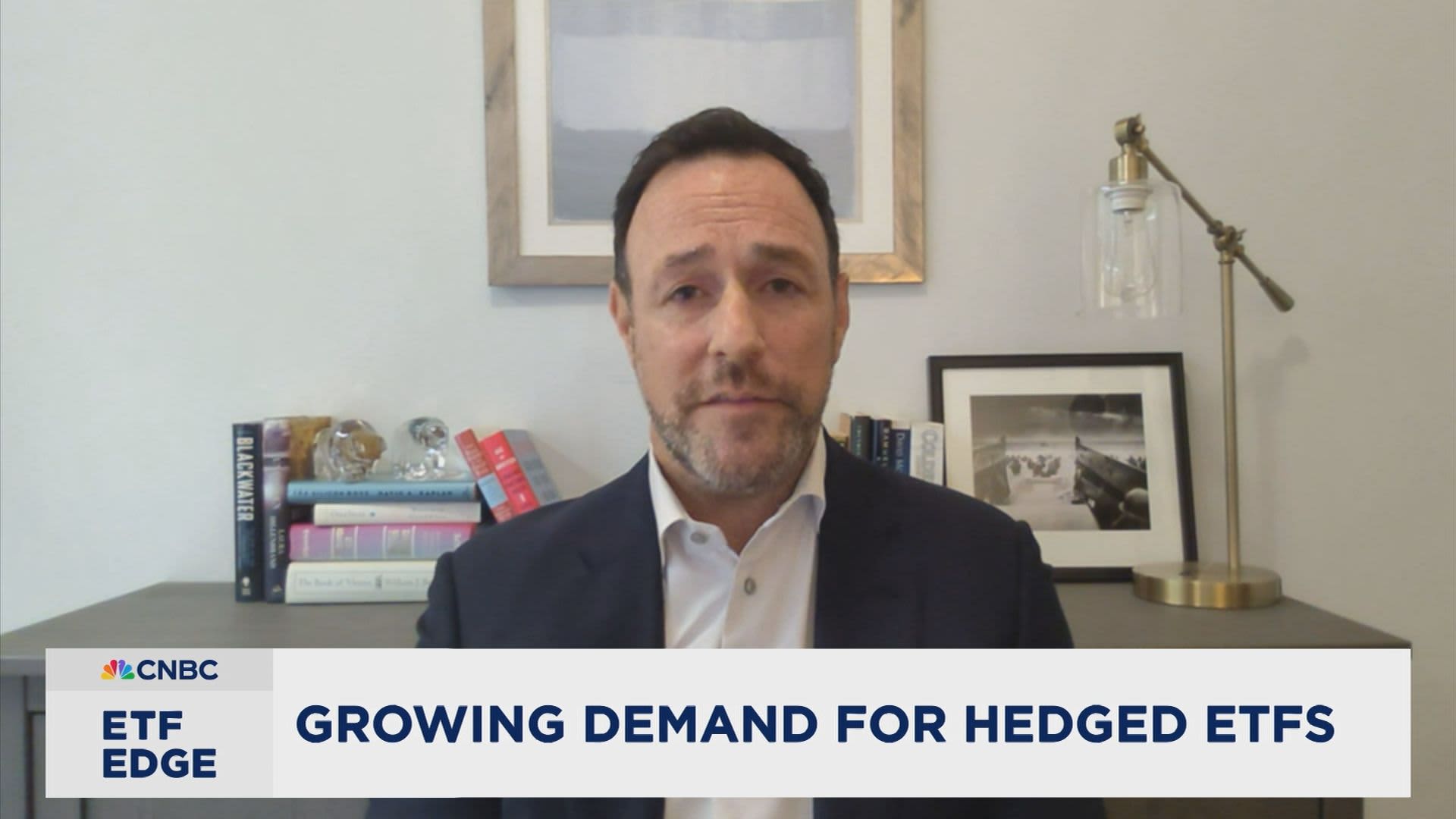
“It’s gone meteoric,” said Mike Loukas, TrueShares ETFs CEO, on CNBC’s “ETF Edge.”
According to a Morningstar report from April, the buffered ETF category has returned about 11% per year over five years. Assets in the category have ballooned to more than $30 billion, with billions in new inflows each year.
“A great deal of wealth is moving from the accumulation phase to the distribution phase. Now a lot of those investors still need growth, but they need growth with risk protection and the defined outcome space,” Loukas said.
That also means there is a big shift in investor mindset, with less investors focused on keeping up with or beating the S&P 500. Now, according to Loukas, retirees are aiming for what he called “performance that’s good enough” — steady, predictable returns that match their comfort level.
But there is another tradeoff in addition to the lagging in strong bull markets as a result of their structure: higher costs. Buffered ETFs usually charge around 0.75% to 0.85% in annual fees, compared with 0.03% for a plain equity index ETF like Vanguard’s VOO or the SPDR S&P 500 SPY. But for retirees focused on capital preservation, diversification, and peace of mind, the extra cost may be worth it.
“These are essentially math-based products,” Loukas said. “They typically will deliver on what they’re supposed to deliver on.”
Biggest buffered equity ETFs
- FT Vest Laddered Buffer ETF (BUFR): $7.9 billion in assets/0.95% net expense ratio
- Innovator Defined Wealth Shield ETF (BALT): $1.9 billion in assets/0.69% net expense ratio
- FT Vest Laddered Deep Buffer ETF (BUFD): $1.5 billion in assets/0.95% net expense ratio
- Innovator Equity Managed Floor ETF (SFLR): $1.2 billion/0.89% net expense ratio
Source: ETFAction.com