Members of media chat before the start of a press conference by Aramco at the Plaza Conference Center in Dhahran, Saudi Arabia November 3, 2019.
Hamad I Mohammed | Reuters
Saudi Aramco’s first-quarter net profit fell 5% year-on-year amid lower oil prices and production.
Net income for the three months to March 31 came in at $26 billion, down from $27.3 billion for the same period last year, the company reported. The figure was slightly above analyst expectations of $25.3 billion.
Aramco announced its free cash flow for the quarter at $19.2 billion, down from $22.8 billion in the first quarter of 2024, and cash flow from operating activities at $31.7 billion compared to last year’s $33.6 billion.
The figures signal continuing strain for the Saudi state oil giant’s balance sheet as crude prices show no sign of recovering and global demand slows in line with pressures on trade.
The company in March announced it would be slashing its performance-linked dividend payout for the fourth quarter of 2024 to $200 million — down from $10.2 billion the previous quarter — and repeated that $200 million figure for the first-quarter of this year, to be paid in the second quarter.


Its first-quarter base dividend excluding the performance-based payouts increased by 4.2% year-on-year to $21.1 billion. But if assessed in total, the dividend fell from $31 billion in the same period last year to $21.36 billion now, due to the cut to its performance-linked element.
“Global trade dynamics affected energy markets in the first quarter of 2025, with economic uncertainty impacting oil prices,” Aramco CEO Amin Nasser said in a statement accompanying the earnings report.
“In this context, Aramco’s robust financial performance once again demonstrated the Company’s unique scale, its reliability and flexibility, the value of its lowcost operations … Such periods also highlight the importance of disciplined capital planning and execution while we continue to take a long-term view.”
Nasser added, “In volatile times Aramco’s resilience underpins both our financial performance and our sustainable and progressive base dividend.”
Bearish oil market ahead
The massive dividend reduction eases pressure on Aramco itself, but means less revenue for the Saudi government as it faces widening deficits and mounting debt due to costly megaprojects and lower oil prices.
The kingdom also constrained its oil revenue potential by maintaining months of coordinated OPEC+ production cuts meant to stabilize the market. That policy changed dramatically after Saudi Arabia and several of its OPEC+ allies announced a shock acceleration to production increase plans in April, even as markets and crude prices were tanking on the news of U.S.-imposed global tariffs.
In early May, OPEC+ again raised its production target for June by 411,000 barrels per day — the second consecutive month of accelerated unwind of the 2.2 million-barrel per day voluntary cuts that had been in place since the start of 2024.
Banks and energy agencies have steadily downgraded their oil price outlooks for the year, anticipating large supply gluts and weak demand. The U.S. Energy Information Administration’s latest forecast sees Brent crude averaging $65.85 per barrel this year, while Morgan Stanley cut its price outlook to $62.50 per barrel in the second half of this year, down by $5 per barrel from the bank’s previous forecast.
Morgan Stanley also predicts a market glut of up to 1.1 million barrels per day in the second half of 2025 — an increase of 400,000 bpd from its previous surplus call.
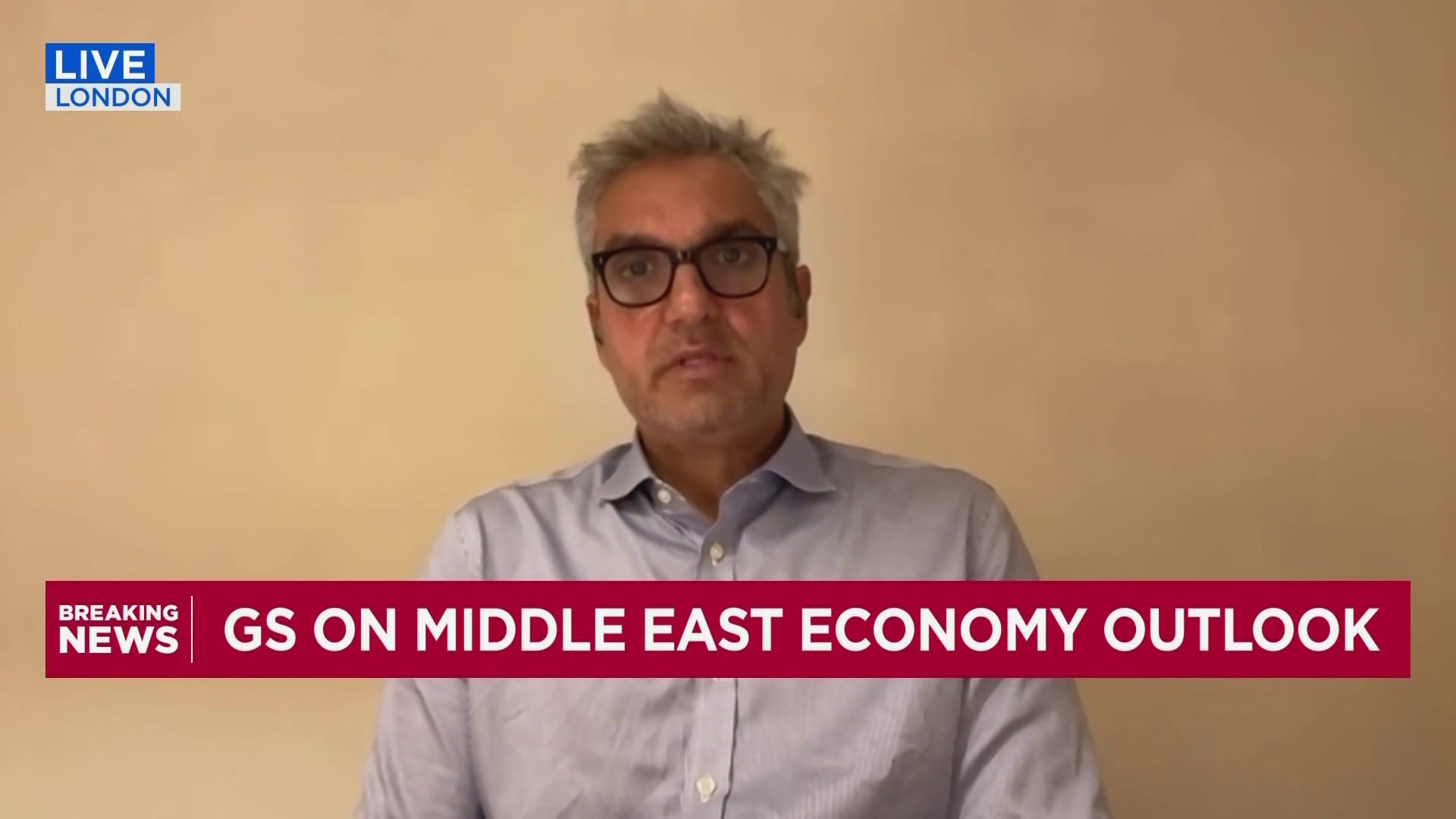
Goldman Sachs, meanwhile, sees Brent averaging $60 per barrel in the remainder of 2025, compared to $63 previously, and $56 per barrel in 2026, compared to $58 previously.
Saudi Arabia needs oil at more than $90 a barrel to balance its budget, the International Monetary Fund estimates. Goldman Sachs in mid-April warned that Brent crude at $62 a barrel — its price forecast at the time — could more than double the kingdom’s 2024 budget deficit of $30.8 billion.
“In Saudi Arabia, we estimate that we’re probably going to see the deficit go up from around $30 to $35 billion to around $70 to $75 billion, if oil prices stayed around $62 this year,” said Farouk Soussa, MENA economist at Goldman Sachs. The bank’s forecast for the rest of 2025 now sits at $60 per barrel.
“That means more borrowing, probably means more cutbacks on expenditure, it probably means more selling of assets, all of the above,” Soussa told CNBC last month. “And this is going to have an impact both on domestic financial conditions and potentially even international.”