Chinese tech company Baidu announced Monday it can sell some robotaxi rides without any human staff in the vehicles.
Baidu
BEIJING — Chinese robotaxi companies are expanding abroad at a faster clip than U.S. rivals Waymo and Tesla — at a time when industry leaders say autonomous driving is finally near an inflection point.
“I think robotaxi has reached a tipping point, both here in China and in the U.S.,” Baidu CEO Robin Li said Tuesday on an earnings call, according to a FactSet transcript.
“There are enough people who have [had the] chance to experience driverless rides, and the word of mouth has created positive social media feedback,” he said, noting that the wider public exposure could speed up regulatory approval.
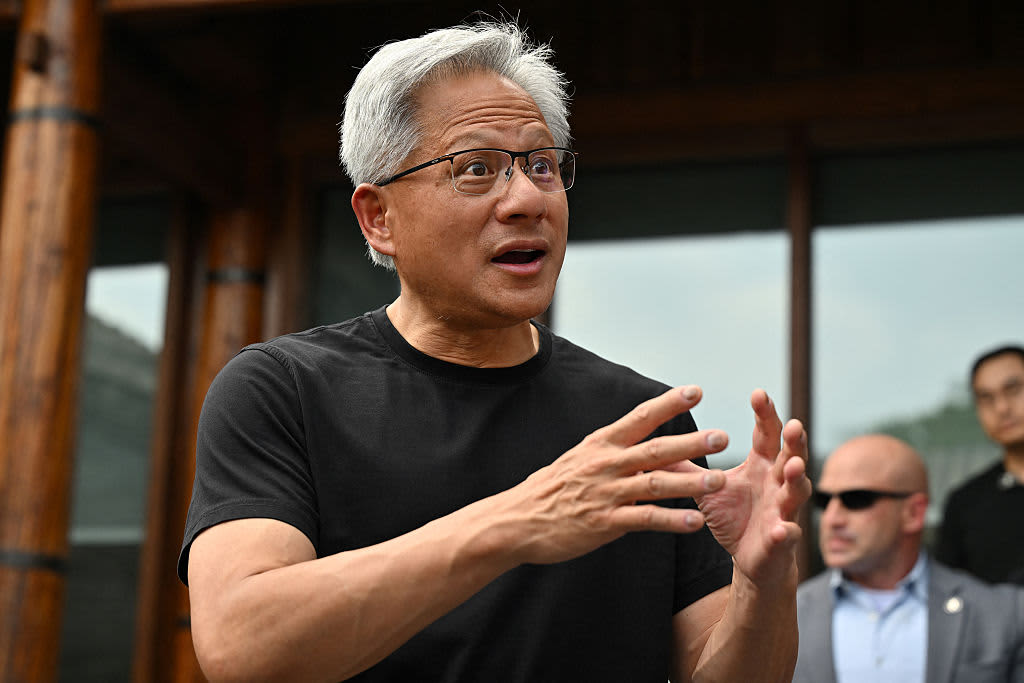
His comments echoed similar notes of optimism in the last few weeks from Nvidia CEO Jensen Huang and Xpeng Co-President Brian Gu — who reversed his previously cautious stance after faster-than-anticipated tech advances. Xpeng is launching robotaxis in the southern Chinese city of Guangzhou next year.
It’s a global market with significant growth potential, likely worth more than $25 billion by 2030, according to Goldman Sachs’ estimates in May.

To seize that opportunity, Chinese companies are aggressively expanding overseas and claim they are close to making robotaxis a viable business, rather than simply burning cash to grab market share.
In the last 18 months, Baidu, Pony.ai and WeRide landed partnerships with Uber that allow users of the ride-hailing app to order a robotaxi in specific locations, starting in the Middle East.
Such tie-ups “will be critical to success” as they enable robotaxi companies to operate more efficiently and reach profitability more quickly, said Counterpoint Senior Analyst Murtuza Ali.
Once we can generate profit for every single car in a second-tier city [like Wuhan] in mainland China, we can generate profits in lots of cities across the world.
Halton Niu
General manager for Apollo Go’s overseas business
Expanding on experience at home
Baidu says that since late last year, its Apollo Go robotaxi unit has reached per-vehicle profitability in Wuhan, where the company has operated over 1,000 vehicles in its largest deployment in China.
That means ridership is enough to offset a Wuhan taxi fare that’s 30% cheaper than in Beijing or Shanghai, and far below prices in the U.S. or Europe. Besides developing autonomous driving systems, Baidu has also produced electrically-powered robotaxi vehicles — without relying on a third-party manufacturer — that are 50% cheaper.
“Once we can generate profit for every single car in a second-tier city [like Wuhan] in mainland China, we can generate profits in lots of cities across the world,” Halton Niu, general manager for Apollo Go’s overseas business, told CNBC.



“Scale matters,” he said. “If you only deploy, for example, 100 to 200 cars in a single city, if you only cover a small area of the city, you can never become profitable.”
How U.S. rivals stack up
Scale remains the dividing line. In the U.S., Alphabet-owned Waymo operates more than 2,500 vehicles and is expanding rapidly from major cities in California to Texas and Florida, with plans to enter London next year, following its first overseas venture in Tokyo.
Tesla sells its electric cars in China, and reportedly showed off its Cybercab in Shanghai this month. But it began testing its robotaxis in Texas only in June, and this week obtained a permit to operate in Arizona.
Amazon’s Zoox is also ramping up its expansion in the U.S., but has not released overseas plans.
The three companies have not disclosed plans to break even on their robotaxis.
Baidu Apollo Go’s Niu did not rule out an expansion into the U.S. But for now, the robotaxi operator plans to enter Europe with trials in parts of Switzerland next month, following their expansion in the Middle East this year.
Abu Dhabi last week gave Apollo Go a permit to charge fares to the public for fully driverless robotaxi rides, which are operated locally under the AutoGo brand, eight months after local trials began in parts of the city.
But Chinese startup WeRide said it received a similar permit on Oct. 31 to charge fares for its fully driverless robotaxi rides in Abu Dhabi, and claimed that removing human staff from the cars would allow it to make a profit on each vehicle.
That puts Pony.ai furthest from profitability among the three major Chinese robotaxi operators. Its CFO Leo Haojun Wang told The Wall Street Journal in mid-September that the company aimed to make a profit on each car by the end of this year or early next year.

Pony.ai plans to launch a fully autonomous commercial robotaxi business in Dubai in 2026, after receiving a testing permit in late September. The company plans to roll out in Europe in the coming months and has also outlined an expansion into Singapore.
Pony.ai and WeRide are set to release quarterly earnings early next week.
“Currently, companies like Waymo, Baidu, WeRide and Pony.ai are leading in terms of fleet size, which positions them advantageously in the race for profitability,” said Yuqian Ding, head of China Autos Research at HSBC.
Scale and safety
Fleet size is becoming a competitive marker. Pony.ai reportedly said it plans to release 1,000 robotaxis in the Middle East by 2028, while WeRide aims to operate a fleet of 1,000 robotaxis in the region by the end of next year.
Niu said Apollo Go operates around 100 robotaxis in Abu Dhabi and Dubai, and plans to double its vehicle fleet in the next few months.
“Apollo Go has had a head start with significantly more test rides than the other two,” Kai Wang, Asia equity market strategist at Morningstar, said in an email. “The more testing and data you can collect from trips taken, the more likely the AI sensors are able to recognize the objects on the road, which means better safety as well.”
He cautioned that despite some initial progress, the robotaxi race remains uncertain as “no one has truly had mass adoption for their vehicles.”

Subscribe now
Coverage remains limited. Even in China, robotaxis are only allowed to operate in selected zones, though Pony.ai recently became the first to win regulatory approval to operate its robotaxis across all of Shenzhen, dubbed China’s Silicon Valley. In Beijing, self-driving taxis are mostly limited to a suburb called Yizhuang.
Anecdotally, CNBC tests have found Pony.ai offered a smoother ride than Apollo Go, which was prone to hard braking.
As for safety — which is critical for regulatory approval — none of the six operators has reported fatalities or major injuries caused by the robotaxis so far. But Apollo Go and Waymo have begun advertising low airbag deployment rates.
Even if that’s not enough to convince regulators worldwide, Beijing is expected to ramp up support at home.
HSBC’s Ding predicts the number of robotaxis on China’s roads could multiply from a few thousand to tens of thousands between the end of this year and 2026, a shift that would give operators more proof that their model works.