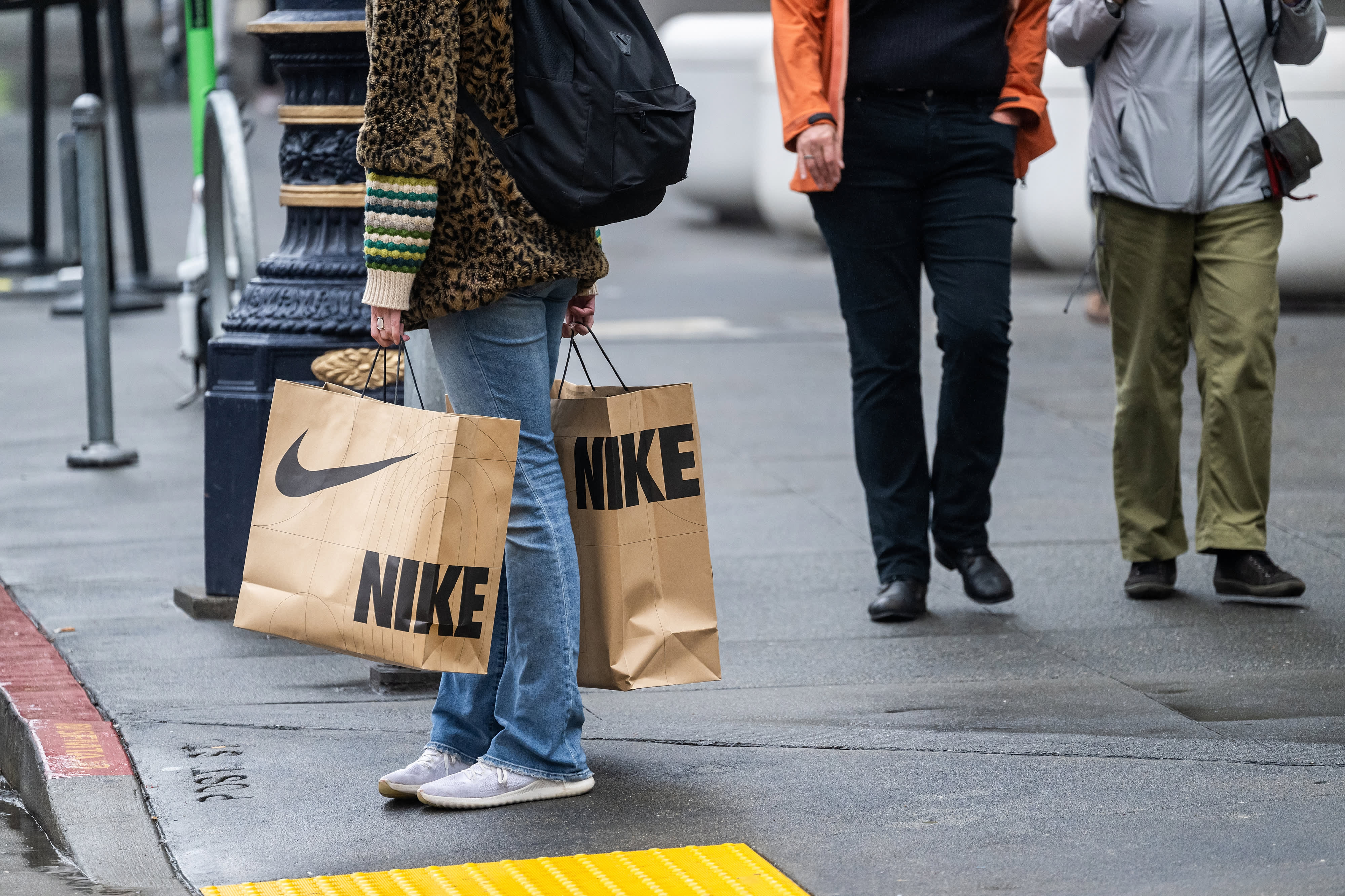
Nike on Tuesday posted surprise sales growth in its fiscal first quarter but said it still has work ahead to execute its turnaround as it warned it expects sales to fall again during most of the holiday shopping season.
Nike expects sales during its current quarter, which runs generally from early September to early December, to fall by a low single digit percentage, in line with expectations of a 3% decline, according to LSEG. Without favorable foreign exchange rates, sales could come in even lower, as the company said its guidance includes a 1 percentage point of positive impact from exchange rates.
Nike has made progress in its turnaround plan, but the expected decline during most of the holiday shopping months would follow an 8% drop in revenue in the year-ago period. It’s a sign to investors that Nike’s recovery is moving slowly, even during the busiest time of the year for retailers.
Higher tariff costs are hampering Nike’s efforts to turn around its business. The company now expects tariffs to cost it $1.5 billion and hit its gross margin by 1.2 percentage points in its current fiscal year 2026. That’s up from the $1 billion and 0.75 percentage point gross margin impact it projected in June.
During its current quarter, Nike said it expects its gross margin to fall between 3 and 3.75 percentage points.
In a press release, finance chief Matt Friend warned that “progress will not be linear.”
“I’m encouraged by the momentum we generated in the quarter, but progress will not be linear as dimensions of our business recover on different timelines,” said Friend. “While we navigate several external headwinds, our teams are focused on executing against what we can control.”
Here’s how Nike performed during the quarter compared with what Wall Street was anticipating, according to consensus estimates from LSEG:
- Earnings per share: 49 cents vs. 27 cents expected
- Revenue: $11.72 billion vs. $11.0 billion expected
Nike’s reported net income in the three months ended Aug. 31 was $727 million, or 49 cents per share, compared with earnings of $1.05 billion, or 70 cents per share, in the year-ago quarter.
Sales rose to $11.72 billion, up about 1% from $11.59 billion a year earlier.
Revenue rose 1% during the quarter after Nike previously said it anticipated sales would fall by a mid-single digit percentage in the period. Still, Nike’s profits fell 31% while gross margin dropped 3.2 percentage points to 42.2% during the quarter — another warning sign to investors that its efforts to clear through old inventory are still ongoing.



In a statement, CEO Elliott Hill said the company is making strides in three key areas: wholesale, running and North America. During the quarter, wholesale revenue rose 7% to about $6.8 billion, while sales in North America climbed 4% to $5.02 billion — better than the $4.55 billion analysts were expecting, according to StreetAccount.
However, beyond those three areas, Hill acknowledged parts of the business are still struggling, primarily its China segment, Converse brand and its direct business, which includes stores and online sales.
During the quarter, Nike direct sales fell 4% to about $4.5 billion, while Converse sales dropped 27%. Revenue in China — one of the company’s most important markets — was down 9%.
“Greater China, as I mentioned on the last call, is facing structural challenges in the marketplace,” Hill told analysts on a conference call. “Seasonal sell through continues to underperform. Our plans require larger investments to keep the marketplace clean.”
The company said it expects revenue and gross margin headwinds to continue throughout fiscal 2026 in both China and at Converse. Nike does not expect its direct business to return to growth in fiscal 2026.
Since Hill took over nearly a year ago, he’s been working to get Nike back to growth and undo some of the work his predecessor John Donahoe implemented. One of the most important parts of that strategy has been reigniting Nike’s innovation engine and clearing through stale inventory to make way for new styles.
Though the strategy is crucial to Nike’s efforts to grow again and take back market share, it comes with pain in the short term. Clearing out old inventory has required Nike to rely on discounting and less profitable sales channels to move products, which has impacted its profitability.
During the quarter, inventories were down 2% compared to the prior year as units decreased, which was offset by increased product costs related to higher tariffs. Hill and Friend made it clear during the call with analysts that its inventory efforts are ongoing. While progress is going to depend on the respective geographies and channels, Nike said its expects its gross margin to benefit from less clearance in the second half of the year.
Beyond inventory management, Hill has also pledged to realign Nike’s corporate structure so it would once again segment teams by sport instead of by women’s, men’s and kids. In late August, the company started shuffling teams. As part of the restructuring, Nike said it would cut around 1% of its staff, and most employees would be moved into new roles by Sept. 21.
The realignment impacted around 8,000 employees but is expected to drive growth as the teams get to work, said Hill. It is unclear how many of those employees were moved to new positions and how many were laid off.
“This new formation and ways of working will align our three brands, Nike Jordan and Converse into more nimble focused teams by sport. We’ll gain sharper insights to fuel innovation and storytelling and connect with the communities of each sport in more meaningful ways,” said Hill.
“Collectively, we’ll have a better coordinated attack with each brand forming a distinct identity and delivering a clear attention to serve different consumers,” he added. “In the marketplace, organizing by sport, gives us a much clearer point of view.”
Hill cited Nike’s “House of Innovation” in New York, a redesigned retail experience that segments the store by sports, as an example of how the strategy works. He said the refresh has led to double-digit increases in revenue and a similar, smaller-format approach in Texas showed similar results.
Hill has said a focus on sports over lifestyle will help the company win back its crucial athlete consumer, but lifestyle merchandise is still an important part of the strategy because it allows Nike to reach a larger consumer segment, and more women. Growing the number of female customers has been another important part of Hill’s strategy and Nike’s recent partnership with Kim Kardashian’s shapewear brand Skims is one of the ways it’s getting there.
NikeSKIMS, originally slated to release in the spring, officially launched last week. Hill told analysts the “early consumer response” has been “very strong.”