Narendra Modi, India’s prime minister, during the nation’s Independence Day ceremony at Red Fort in New Delhi, India, on Friday, Aug. 15, 2025.
Bloomberg | Bloomberg | Getty Images
Indian markets rallied on Monday as Prime Minister Narendra Modi’s recently revealed tax cuts extended a gift to a domestic economy that still faces the teeth of U.S. tariffs.
The Nifty 50 index advanced 1%, with the BSE Sensex adding 0.84%. In currencies, the U.S. dollar surrendered 0.18% against the rupee.
In an extensive Independence Day speech on Friday, Prime Minister Narendra Modi made a concerted push for self-reliance and proposed a spate of financial reforms. New Delhi now plans a two-rate structure of 5% and 18% under wide-spanning changes to the goods and services tax (GST) regime, and plans to abolish the previous 12% and 28% levies imposed on some items, Reuters cited a government official as saying on Friday. The news was also reported by local media.
“The reforms aim to simplify compliance, lower tax rates, and modernise the GST framework to make it more growth-oriented. Industry executives expect measures such as rationalising rates into two slabs, easing the tax burden on micro, small and medium enterprises (MSMEs), cutting levies on essential goods, and using technology-driven processes like pre-filled returns and faster refunds to encourage investment,” the India Brand Equity Foundation said, adding that manufacturing, logistics, housing and consumer goods could stand to gain.
India’s autos industry could also emerge as one of the beneficiaries of the new tax policies after a sluggish stretch in recent months. Sales of India’s passenger vehicles, which include cars, added 4.2% percent in the 2024 calendar year, the Society of Indian Automobile Manufacturers said in January – the slowest growth pace in four years, according to Reuters.
Auto sector stocks saw increases during the Monday session, as Maruti Suzuki India adding 8.75%, while Hyundai Motor India rose by 8.15%.
“I’m certainly positive about the announcement, and the autos sector being a relative laggard in recent quarters, so not surprising to see that sector bounce back quite strongly,” James Thom, senior investment director on the Asian equities team at Aberdeen, told CNBC’s “Inside India on Monday.”
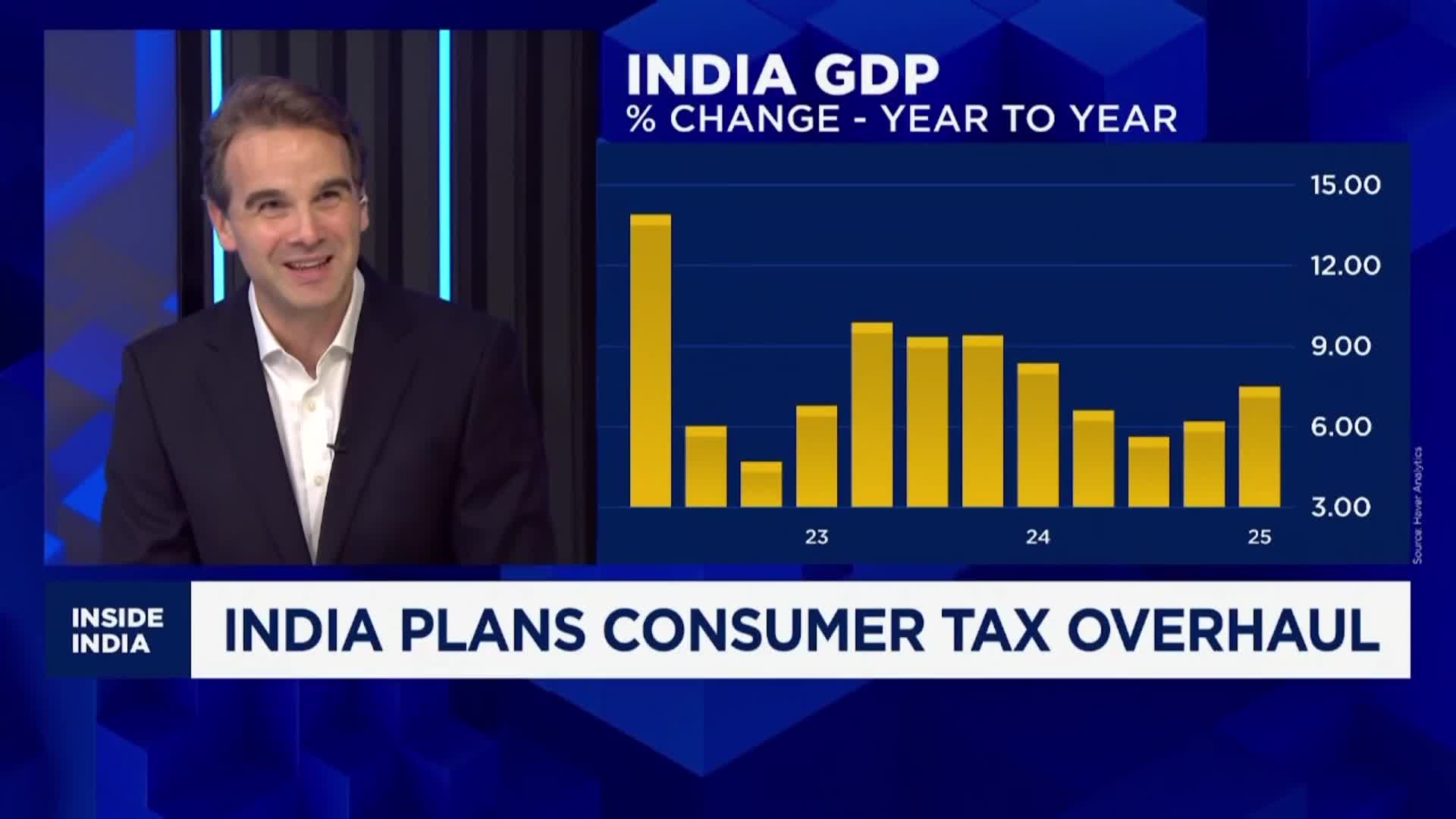
Modi’s tax overhaul could shore up India’s economy, which the Reserve Bank of India sees growing 6.5% in the 2025-2026 fiscal year, at a time of deep geopolitical uncertainty stoked by Washington’s sweeping so-called “reciprocal tariffs.” New Delhi in particular has fallen in the crosshairs of U.S. President Donald Trump’s administration over its ongoing purchases of Russian crude, with Washington imposing an additional 25% levy on Indian imports — bringing total duties to 50% — due to take effect at the end of this month.
“India is a domestic consumption story. Exports is a relatively small contributor. So this [tax overhaul] could more than offset that impact of tariffs,” Aberdeen’s Thom said.
“From a fundamental standpoint, absolutely, I think the changes to the GST regime will be supportive near-term for consumption as it comes through later in the year. And consumption has been weak in India for quite some time now, so this is a real sort of boost to the economy, if you like, given India’s economy is so dependent on domestic consumption.”
Domestic intake is “one of the most compelling indicators investors are closely monitoring,” and the “largest driver of economic growth in India,” with a 61.4% GDP contribution in the 2024-25 fiscal year, Deloitte said in an August report.
“Notably, urban consumption and a shift in spending preferences toward luxury goods are emerging as key pillars of this momentum,” it said.
India Ratings & Research meanwhile forecast India’s private final consumption rate in the fiscal year to the end of March 2026 will expand by an annual 6.9%, outpacing a broader 6.3% GDP growth outlook over the period, on the back of low real wage increases, declines in household savings and a boost to personal loans.
“A sharp decline in inflation has improved the prospects for stable consumption growth in FY26,” it added. India’s retail inflation has slowed from 4.31% in January to its lowest since 2017 at 1.55% in July.