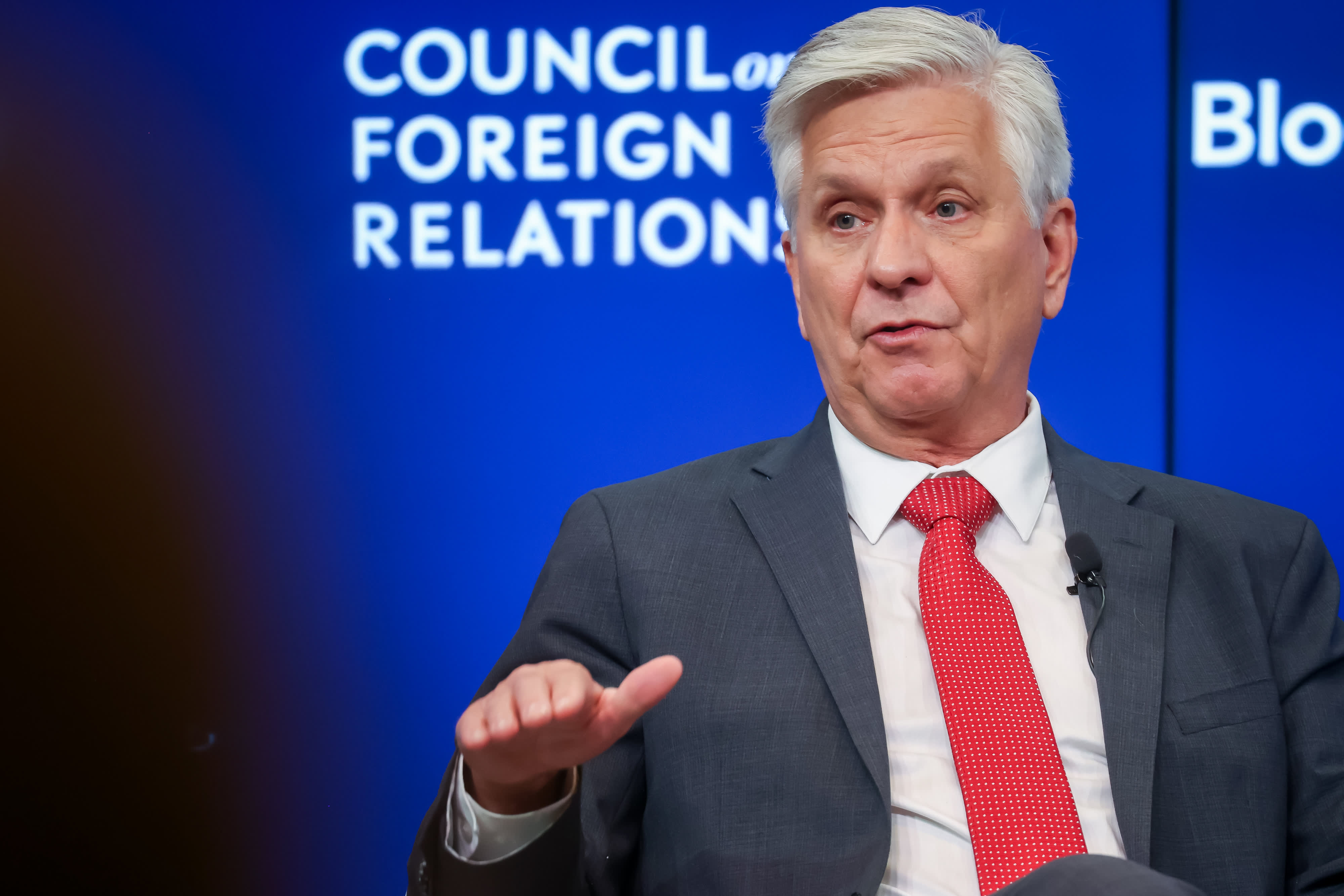
Less than a week after taking his seat, Federal Reserve Governor Stephen Miran on Monday outlined the reasons why he thinks the central bank’s benchmark interest rate is far too high and should be lowered aggressively.
Changes in tax and immigration policy along with easing rental costs, deregulation and incoming revenue for tariffs are creating a different economic landscape that allow the Fed to cut its benchmark rate by nearly 2 percentage points from its current level, the central banker said in remarks before the Economic Club of New York.
“The Federal Reserve has been entrusted with the important goal of promoting price stability for the good of all American households and businesses, and I am committed to bringing inflation sustainably back to 2 percent,” he said. “However, leaving policy restrictive by such a large degree brings significant risks for the Fed’s employment mandate.”
Miran sees the confluence of policy changes from the White House lowering the neutral level of interest that neither restricts nor promotes growth. In remarks heavy with data and citations on theory and interest rate models such as the Taylor Rule, Miran said current monetary policy is significantly more restrictive than the prevailing attitude among his fellow policymakers.
Using standard policy rules, Miran thinks the federal funds rate, a level that banks charge each other for overnight lending but that influences a wide variety of other rates, should be in the low-2% area. The current funds rate following last week’s reduction is targeted between 4%-4.25%.
“The upshot is that monetary policy is well into restrictive territory,” he said. “Leaving short-term interest rates roughly 2 percentage points too tight risks unnecessary layoffs and higher unemployment.”
The views, however, put Miran well outside consensus on the Federal Open Market Committee, where the current approach advocates more caution and a tepid move lower in rates over the next several years.


At its meeting last week, the FOMC voted 11-1 to lower by a quarter percentage point. Miran was the sole dissenter, opting for a half-point cut and putting his individual dot on the committee’s “dot plot” of expectations in a place that would imply another 1.25 percentage points in reductions this year.
Earlier Monday, St. Louis Fed President Alberto Musalem, who like Miran is a voter on the FOMC this year, said he sees little room for further cuts. Likewise, Atlanta President Raphael Bostic — who doesn’t vote this year — also told The Wall Street Journal he would not support further reductions this year.
President Donald Trump appointed Miran to the Fed position following former Governor Adriana Kugler’s surprise resignation in early August. Like Trump, Miran has been a harsh Fed critic, though he and others described the air at the meeting as collegial and professional.
Miran pressed his case Monday for lower rates, insisting that inflation is on its way down, particularly in the housing market where cooling rents that had not shown up in the data now will become more apparent.
Though pushing for cuts, Miran said he is optimistic about economic growth, two positions that under conventional thinking would be at odds.
“My view is that policy is roughly 2 points too restrictive, which is considerably restrictive,” he said during a question-and-answer session after his speech. “Even though I am expecting growth to be a little better in the future, that could get derailed unnecessarily so and create an output gap where one need not exist if we don’t get policy closer to neutral.”
He further cited other administration policies, such as its clamp down on immigration, its move to lower business regulations and cut taxes, and the revenue that will be generated from tariffs and its impact on the budget deficit as disinflationary factors.
“Labor market statistics and anecdotal evidence suggest border policy is exerting a major impact on the economy,” he said. “America’s regulatory patchwork has become a material impediment to growth.”
Economists at the Fed and elsewhere continue to worry that Trump’s tariffs will have a longer-term upward push on inflation. However, Miran said “relatively small changes in some goods prices have led to what I view as unreasonable levels of concern.”
Recent inflation readings, though, have shown prices moving higher and further away from the Fed’s 2% inflation mandate.
Miran is expected to fill the remainder of a term that expires in Jan. 31, 2026, then move back to his position as chair of the Council of Economic Advisers. He peppered his speech with references to CEA research.