Shoppers carry Macy’s bags outside of Macy’s flagship store on Black Friday in New York, US, on Friday, Nov. 28, 2025.
Adam Gray | Bloomberg | Getty Images
Andre Lewis said he’s “anxious 364 days of the year.” Yet the rideshare and delivery driver wants to make it a special holiday season for his 7-year-old daughter.
“I told myself I’d keep it modest,” said the 31-year-old, who lives in New York City. But he said his daughter wants a pink keyboard that lights up, and he’ll buy it for her — “even if it’s a little over budget.”
“Christmas is the one day I let myself stop worrying,” he said.
For many U.S. consumers like Lewis, economic worries have cast a cloud over an otherwise cheery season. Consumer sentiment fell to its lowest level in more than three years in early November, close to its all-time low, according to University of Michigan’s monthly survey. The metric posted a slight uptick in December.
Yet so far, that downbeat backdrop hasn’t stopped shopping this year or dragged down the typical kickoff of the holiday season. That apparent contrast has left investors and economists wondering whether — and when — jitters over high costs of living, increased tariffs and a tepid job market will start to emerge more in spending data.
Across the country, nearly 203 million U.S. shoppers hit retailers’ stores and websites during the five-day stretch from Thanksgiving Day through Cyber Monday — the highest turnout in at least nine years, according to the National Retail Federation, which surveys shoppers to calculate the annual estimate.
Big-box and club retailers, including Walmart, Best Buy and Costco, topped Wall Street’s quarterly sales expectations, and executives said they saw an encouraging start to the crucial shopping season. Meanwhile, discretionary retailers like Gap, Abercrombie & Fitch and American Eagle also exceeded quarterly estimates, and company leaders said consumer demand has been steady.
“I know everybody’s looking for cracks in consumer health,” Walmart CFO John David Rainey told CNBC in late November. “It feels pretty consistent to us.”
Some executives also said lower-income consumers, who have felt economic pressures most acutely over the last year, have kept spending.
“The headline is that we feel very good about the lower-income customer,” Burlington Stores CEO Michael O’Sullivan said when the company quarterly results last month. “This customer has been very resilient. When we look at our stores in lower-income trade areas, they continue to outperform the chain.”
Some key dynamics have supported U.S. consumer spending, even as concerns about an AI investment bubble and layoffs by companies including Verizon and Target cloud the 2026 economic outlook. Unemployment numbers are still relatively low, though the labor market has slowed. While the U.S. added more jobs than expected in November, the unemployment rate hit the highest level in four years, according to delayed government data released Tuesday. Separate ADP figures showed the private sector unexpectedly lost jobs in November.
Higher-income consumers, in particular, have propped up retail sales as they benefit from rising home values and stock market gains. And holiday spending, in particular, tends to be insulated since families across incomes prioritize the season, even if that means sacrificing other kinds of spending or racking up the credit card bill.
Marcus Feldman, a biotech project manager from Cambridge, Mass., said he will spend about 15% more this year on the holidays. He and his wife plan to take their 9- and 12-year-old sons on a skiing trip, and splurge on nicer gifts.
“It’s partly because we can and partly because life’s short and the boys are only little once,” he said.
And, he added, he’s noticed others spending freely.
“Every headline says people are scared to spend,” he said. “Then I walk down [one of Boston’s major shopping streets] Newbury Street on a Saturday and it’s shoulder-to-shoulder.”
On a call with reporters in early December, National Retail Federation CEO Matthew Shay said “there’s a bit of a moat” around holiday spending, a time when emotions fuel demand.
“One of the key drivers here is that for many Americans and many families, holiday spending and holiday shopping is an essential part of the budget,” he said on the call.
Plus, as interest rates remain high, consumers have put off some of the priciest purchases they typically make, such as new houses and cars. That’s freed up money for spending on goods, said Naveen Jaggi, who leads retail transaction and advisory services at commercial real estate services firm JLL.
Black Friday signage at a Target store ahead of Black Friday in Jersey City, New Jersey, US, on Tuesday, Nov. 25, 2025.
Michael Nagle | Bloomberg | Getty Images
Still, warning signs loom over the economy. Nearly every retailer has said consumers continue to be selective about spending and are looking for deals to stretch dollars. Shoppers’ hunt for deep discounts fueled strong turnout and growth during the sales days known for promotions, including Black Friday and Cyber Monday, according to Adobe Analytics.
Some of the retail spending growth has come from price hikes, which have persisted even as the rate of inflation eases.
After being hit by higher prices for groceries, electricity and housing, consumers are seizing upon sales to get ahead of further price increases.
Eugenio Aleman, chief economist for financial services firm Raymond James, attributes lower consumer sentiment to price hikes. He said that’s accelerated some purchases because shoppers worry prices will keep going up.
“Even though they feel bad, they say, ‘Okay, I have to do whatever it takes to buy now,'” he said.
The say and do gap
The contrast between spending data and consumer sentiment captures a head-scratching gap between what consumers are saying and what they are doing.



That divergence dates back to 2021, soon after the Covid pandemic, when surveys of consumer spending intentions became less predictive of their behavior, said Ali Furman, the U.S. consumer markets industry leader for consulting firm PwC.
In particular, she said PwC has seen higher-income households and those on the East and West Coasts more likely to keep spending, even as they report a low sentiment.
That gap influenced PwC’s own holiday forecast. Its consumer survey during late June and early July indicated that holiday shoppers planned to pull back on purchases from last year, with Gen Z consumers especially slashing their budgets.
Based on that survey, PwC projected that consumers’ average spending on holiday gifts, travel and entertainment would decline 5% from the year-ago period.
Yet in late October, it surveyed consumers again and reversed its projections. PwC now expects consumers across age groups will spend 3% to 4% more on the holidays year over year.
Furman said consumers may have felt a little better in the fall, as some worries about higher tariffs faded and they saw retailers’ holiday merchandise start to hit the shelves.
The durability of consumer spending has even surprised the National Retail Federation, the industry’s major trade group. For the vast majority of months this year, retail sales have climbed nearly or more than 4% year over year, according to U.S. Census Bureau retail figures.
That’s higher than the 2.7% to 3.7% annual year-over-year growth that the trade group predicted.
Companies tread cautiously
It’s not just consumers: Businesses have shown caution about their spending. Holiday hiring by retailers is expected to be the lowest in at least 15 years, according to the NRF, as companies try to manage higher costs from tariffs.
Retailers have also stressed the unpredictability of consumer behavior, even when posting otherwise strong results.
Macy’s, for example, earlier this month reported its strongest growth in more than three years as it made progress on its turnaround strategy. Still, it disappointed Wall Street with a cautious forecast for the holiday quarter. CEO Tony Spring told CNBC that the “customer is hanging in there,” but is still spending selectively.
Costco CFO Gary Millerchip said the warehouse club, which has benefitted from consumers seeking value, has seen “bumpy” trends that have muddied a consistent pattern of consumers spending more and seeking value, quality and new items.
“When you look at month by month, there’s definitely been some lumpiness in the individual monthly sales results that we’ve posted,” he said on an earnings call on Thursday.
The buzzwords retail executives have used in public comments underscore how confusing the consumer backdrop has become. CEOs in recent years have repeatedly called shoppers “choiceful” about their spending.
Yet retailers have also started to describe consumers as “resilient.” In the most recent round of earnings calls, leaders from Macy’s, Burlington Stores, Tapestry, Abercrombie & Fitch and Ralph Lauren all used the word to describe their customers.
At some companies, it’s unclear if healthy results have come from individual execution or a strong economy. The retail industry has been more starkly divided between winners and losers over the last year, and those that are executing well have won the dollars of selective shoppers.
For example, Gap’s Old Navy, which primarily caters to low- and middle-income shoppers, had an “incredibly strong” third quarter, CEO Richard Dickson said. The apparel brand’s comparable sales rose 6%, far better than the 3.8% increase analysts had expected, according to StreetAccount.
Dickson said shoppers responded to value across all income groups, as the brand saw “consistency and strength in our customer behavior.” Still, Gap has been in the midst of a major turnaround and only started posting stronger results after Dickson took over.
Trading down and looking for deals
Black Friday signage inside a Walmart store on Black Friday in Columbus, Ohio, US, on Friday, Nov. 28, 2025.
Brian Kaiser | Bloomberg | Getty Images
Even as U.S. consumers have shown resilience, there have also been clues that they’re making tradeoffs and trying to get more for their money.
Value-oriented retailers including Walmart and Dollar General have attracted more high-income shoppers. Off-price chains like TJX-owned T.J. Maxx and mall names like Gap have also drawn in wealthier shoppers who are looking for home decor and clothing.
Luc Wathieu, a professor of marketing at Georgetown’s McDonough School of Business, said the disconnect between sentiment and spending is a “paradox,” but added shoppers and retailers have left behind a trail of breadcrumbs to explain it. He said holiday season has gotten off to a strong start because people are shopping early around events like Black Friday and Cyber Monday to save money.
Retailers have been able to meet that demand and keep offering deals because of the extra inventory they bought earlier this year to avoid tariffs. Many experts expect companies to sell through those items by the end of the year.
For those reasons, “we should see a very good beginning of the season” but “a pretty bad end of the season,” said Wathieu, the research director of the NRF Business of Retail Initiative at Georgetown.
Consumers also feel like they don’t have control over what’s happening around them during an indulgent season, which is fueling spending despite their negative outlook, Wathieu said.
“It’s a little bit like dancing on the Titanic before it collapses, right?” he said. “We don’t know what’s going to happen. We might as well live our life in the meantime.”
Plus, industry growth so far this season may be more related to inflation than actual strong demand, said Omair Tariq, the founder and CEO of Cart.com, which provides logistics, fulfillment and other services for retailers including Eddie Bauer, Adidas and Guess.
Tariq told CNBC more than half of Cart’s customers confirmed they were raising prices this year, and those companies’ volumes fell after the hikes took effect.
“Conversion dropped, order volume dropped,” Tariq said. “What we saw was that even during Black Friday, Cyber Monday, while there was obviously some growth, it was in in the low single digits.”
In Salesforce’s Cyber Week results, the company found the average selling price over the Thanksgiving selling weekend was up 6% compared to the year-ago period. Meanwhile, volumes only grew 2% globally and 1% in the U.S.
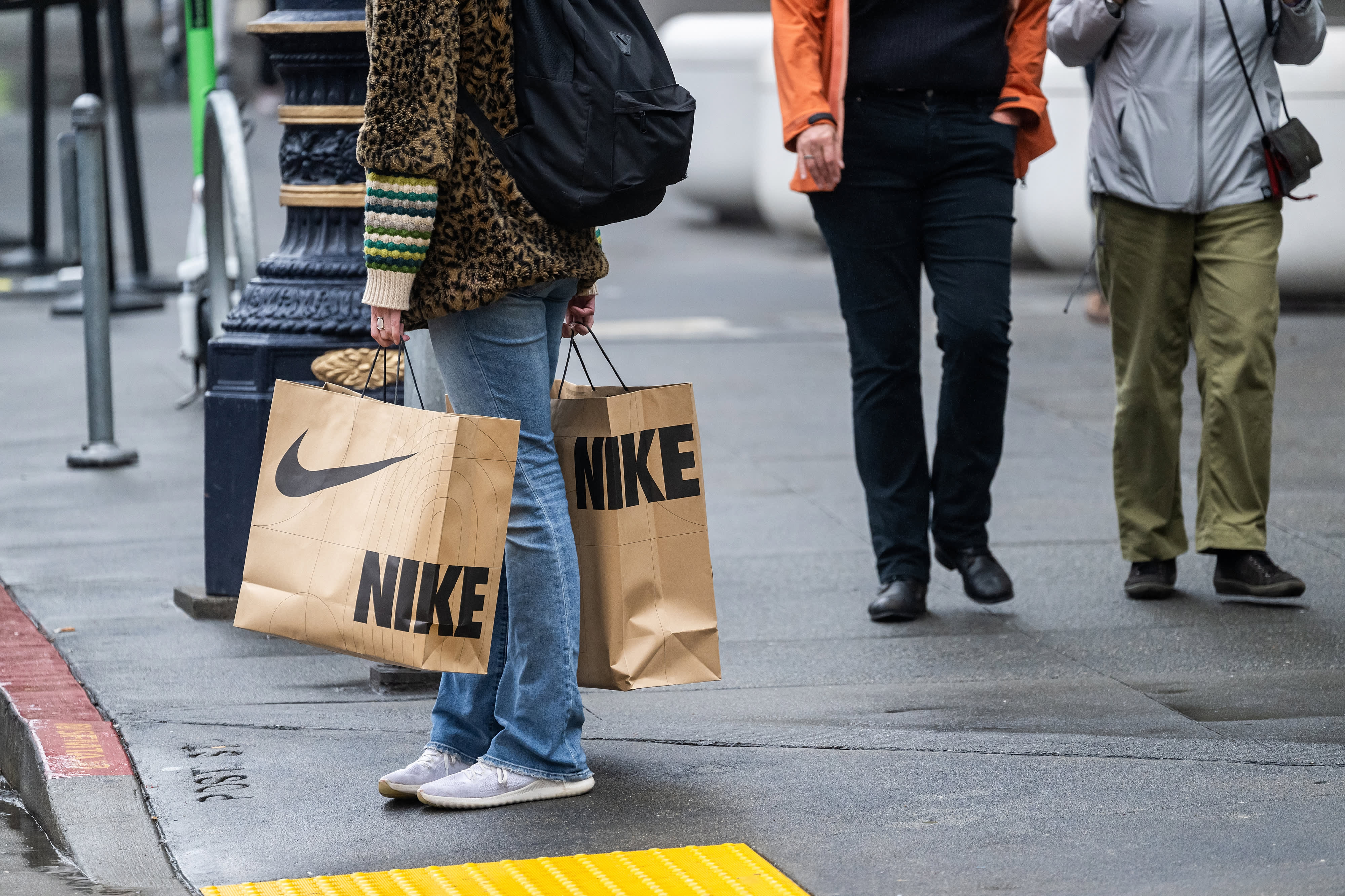
Lewis, the rideshare and delivery driver, shopped at Brookfield Place in downtown Manhattan last week. Income is up and down with his job, he said, but a wave of holiday visitors to New York has boosted business for now. He bought a pair of Nike shoes for his daughter while at the mall.
Yet to make sure he has enough for her, he’s trimmed back in other ways. He’s put off shoe purchases for himself, postponed a phone upgrade and hasn’t taken a trip in over a year.
“I want her to feel like the world is full of possibility,” he said.
— CNBC’s Luke Fountain contributed to this report.