Skip to content
Trending
September 6, 2025Kenvue stock drops 10% on report RFK Jr. will link autism to Tylenol use during pregnancy April 28, 2025Chinese factories are stopping production and looking for new markets as U.S. tariffs bite March 11, 2025Trump says a transition period for the economy is likely: ‘You can’t really watch the stock market’ May 29, 2025Credit default swaps are back in fashion — even if the panic might be overblown May 6, 2025Private payroll growth slowed to 62,000 in April, well below expectations February 24, 2025Jim Cramer says our newest stock is a buy after dipping on slow start to 2025 May 6, 2025Hispanic shoppers are spending less on groceries, putting pressure on consumer companies March 26, 2025Federal housing agency will not cut Fannie Mae and Freddie Mac loan limits, new director says November 30, 2025An industry focused on death faces an existential crisis September 14, 2025Week in review: How we navigated the strong market ahead of the big Fed meeting
  Thursday 9 April 2026
everydayread.net
  • HOME
  • Bitcoin
  • Business
  • Earnings
  • Economy
  • Finance
everydayread.net
everydayread.net
  • HOME
  • Bitcoin
  • Business
  • Earnings
  • Economy
  • Finance
everydayread.net
  Economy  Consumer outlook hits lowest since 2011 as tariff fears mount, Conference Board survey shows
Economy

Consumer outlook hits lowest since 2011 as tariff fears mount, Conference Board survey shows

AdminAdmin—May 7, 20250

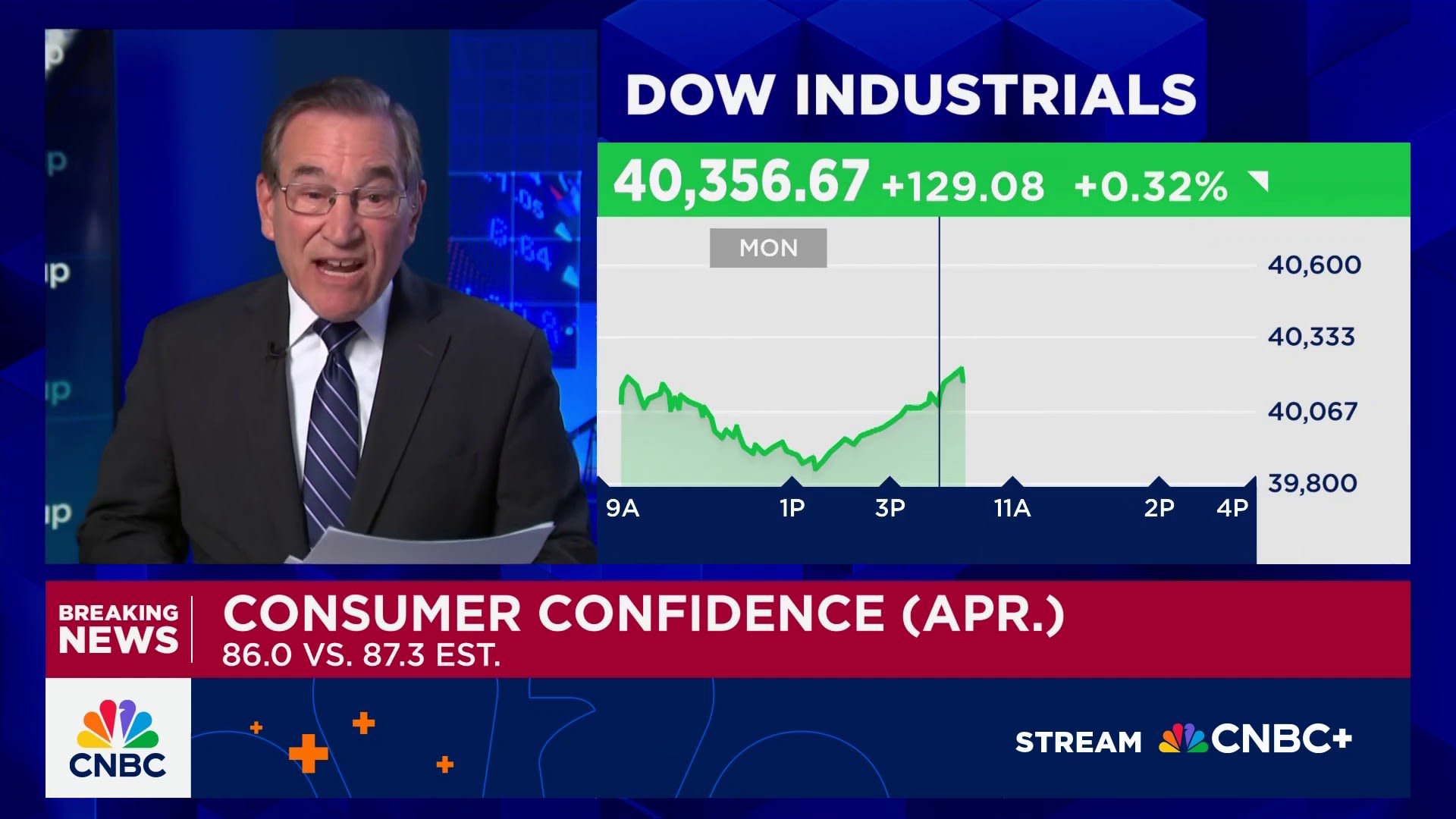
Consumer confidence weakest since April 2020

Consumer attitudes about both the present and near future dimmed again in April, as tariffs dented sentiment and confidence in employment hit levels last seen around the global financial crisis.

The Conference Board’s Consumer Confidence Index fell to 86 on the month, down 7.9 points from its prior reading and below the Dow Jones estimate for 87.7. It was the lowest reading in nearly five years.

However, the view of conditions further out deteriorated even more.

The board’s expectations index, which measures how respondents look at the next six months, tumbled to 54.4, a decline of 12.5 points and the lowest reading since October 2011. Board officials said the reading is consistent with a recession.

More stories

There’s a shocking disparity between how high income and low income earners feel about the economy

October 14, 2025

U.S. budget deficit hit $316 billion in May, with annual shortfall up 14% from a year ago

June 12, 2025

Trump advisor Hassett is confident tariffs will prevail despite judges’ ruling

June 1, 2025

Asian economies scramble to appease Trump as the U.S. president ratchets up tariff threats

February 11, 2025

“The three expectation components—business conditions, employment prospects, and future income—all deteriorated sharply, reflecting pervasive pessimism about the future,” said Stephanie Guichard, the board’s senior economist for global indicator.

Guichard added that the confidence surveys overall were at “levels not seen since the onset of the Covid pandemic.”

Indeed, the level of respondents expecting employment to fall over the next six months hit 32.1%, “nearly as high as in April 2009, in the middle of the Great Recession,” Guichard added. That contraction lasted from December 2007 until June 2009. The level of respondents seeing jobs as “hard to get” rose to 16.6%, up half a percentage point from March, while those seeing jobs as “plentiful” fell to 31.7%, down from 33.6%.

Future income prospects also turned negative for the first time in five years.

The downbeat views extended to the stock market, with 48.5% expecting lower prices in the next 12 months, the worst reading since October 2011. Inflation expectations also surged, at 7% for the next year, the highest since November 2022.

Driving the pessimism was fear over tariffs, which reached an all-time high for the survey. Recession expectations hit a two-year high as well.

In related data Tuesday, the Bureau of Labor Statistics reported that employment postings in March fell to their lowest level since September 2024. The Job Openings and Labor Turnover Survey showed 7.19 million positions, down from 7.48 million in February and below the Wall Street expectation of 7.5 million.

Government postings fell by 59,000 amid President Donald Trump‘s efforts to pare down the federal workforce. Transportation, warehousing and utilities also saw a drop of 59,000.

The JOLTS survey showed hiring was little changed while layoffs fell by 222,000.
Don’t miss these insights from CNBC PRO

Uber misses revenue expectations with trips up 18% over last year
Banks are keeping credit card rates high even after the CFPB rule they blamed for high APRs was killed
Related posts
  • Related posts
  • More from author
Economy

Trust these numbers? Economists see a lot of flaws in delayed CPI report showing downward inflation

December 18, 20250
Economy

Watch Fed Governor Christopher Waller speak on interest rates and the race to succeed Powell

December 17, 20250
Economy

Hassett says Fed independence is ‘really important’ and chair candidates shouldn’t be disqualified for being Trump’s friend

December 16, 20250
Load more
Read also
Finance

Visa says new AI shopping tool has helped customers with hundreds of transactions

December 18, 20250
Economy

Trust these numbers? Economists see a lot of flaws in delayed CPI report showing downward inflation

December 18, 20250
Earnings

Nike tops earnings estimates but shares fall as China sales plunge, tariffs hit profits

December 18, 20250
Business

American Airlines no longer lets basic economy flyers earn miles

December 18, 20250
Finance

Billionaire fund manager Ron Baron praises beaten-up financial stock whose new CEO he compares to Jamie Dimon

December 17, 20250
Economy

Watch Fed Governor Christopher Waller speak on interest rates and the race to succeed Powell

December 17, 20250
Load more
    © 2022, All Rights Reserved.
    • About Us
    • Advertise With Us
    • Contact Us
    • Disclaimer
    • Cookie Law
    • Privacy Policy
    • Terms & Conditions