Shoppers line up to shop at a Laopu Gold outlet in Deji Plaza in Nanjing, China, on Feb. 21, 2025.
Fang Dongxu | Feature China | Future Publishing | Getty Images
BEIJING — Chinese companies’ latest earnings reports point to an improvement in consumer spending, though it’s not necessarily back to pre-pandemic levels.
E-commerce giants Alibaba and JD.com both said in the last several weeks that their China retail business saw faster year-on-year revenue growth in the last three months of 2024 than in 2023.
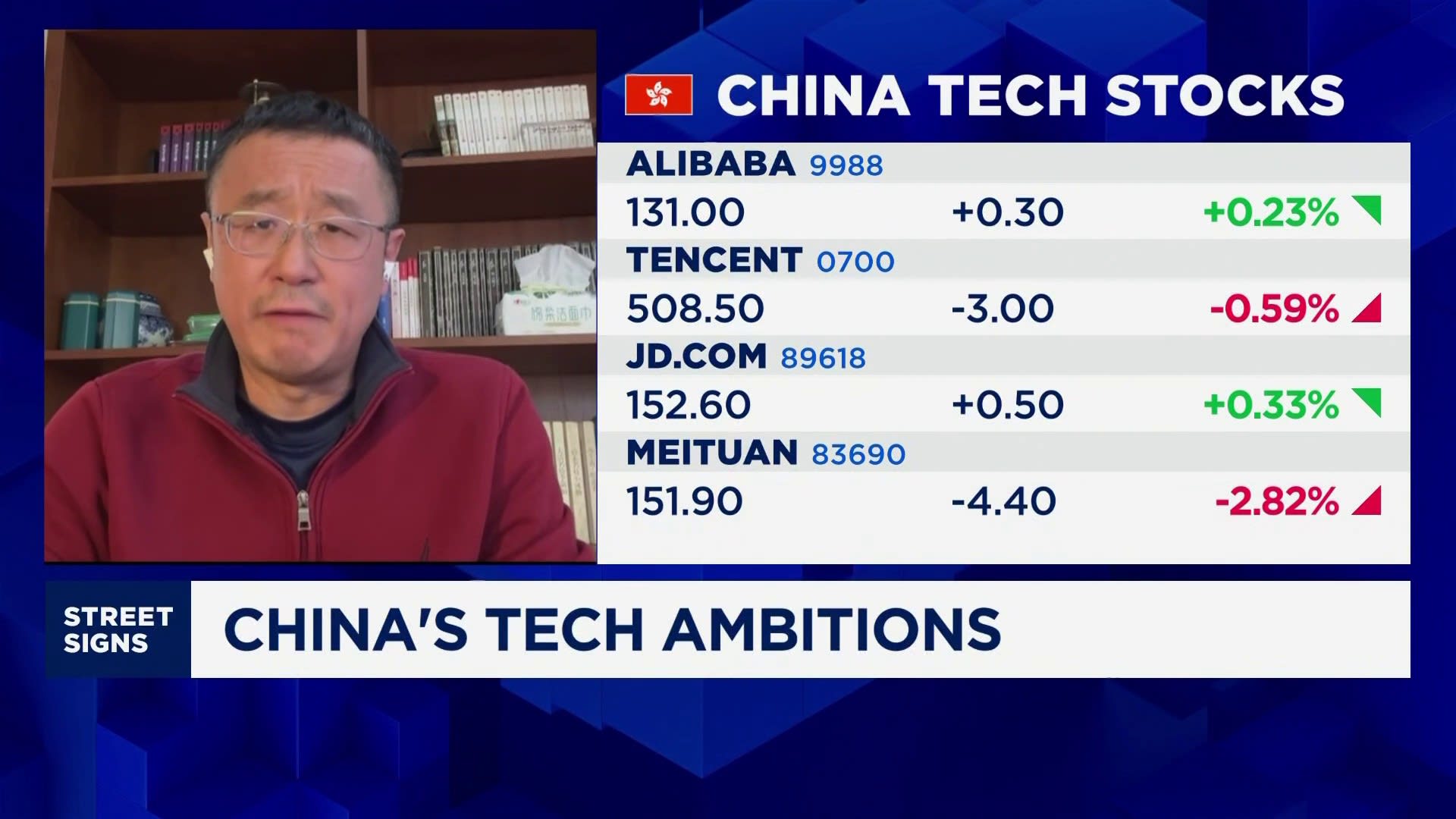
“We think consumption growth is in a period of healthy recovery, but not [yet reaching] the high previously,” Charlie Chen, managing director and head of Asia research at China Renaissance Securities, said Wednesday in Mandarin, translated by CNBC.
For consumer spending to return to pre-pandemic growth, Chinese companies’ revenue growth likely needs to recover by double digits and consumer confidence needs to improve, Chen said. He noted that the recent real estate slump has weighed on consumers’ sense of affluence.
Chinese policymakers have emphasized that boosting consumption is their priority this year. So far, authorities have expanded a trade-in subsidy program to include smartphones, on top of home appliances and electric cars. In September, Beijing also signaled a shift in real estate policy by calling for a halt in the market decline.
JD.com has benefitted directly from the trade-in program, and reported 15.8% year-on-year growth in sales for electronics and home appliances in the fourth quarter of 2024. However, full-year segment revenue of 4.9% was only the fastest growth since 2021, when sales surged by nearly 23%.
The government has introduced consumption-stimulating policies since the second half of last year, and they have “driven a steady recovery in consumer confidence,” Sandy Xu, chief executive officer and executive director of JD.com, said in an earnings call this month, according to a FactSet transcript.
“In short-term we believe there are still challenges on the macro side, but in the long term, we remain very optimistic about consumer sentiment,” she said.
Niche markets stand out
Tencent, which operates mobile payments and social media app WeChat, reported a 3% growth in fintech and businesses services to 56.1 billion yuan ($7.7 billion) in the fourth quarter of 2024, noting that “commercial payment services revenue was broadly stable year-on-year.” That compares with 39% segment growth in the fourth quarter of 2019, which Tencent had attributed to “greater revenue contributions from commercial payment.”
Certain companies have found niche areas where Chinese consumers are spending, however.




In late February, Beijing-based Laopu Gold, which makes and sells gold jewelry with Chinese designs, forecast that its net profit last year surged by at least 236% in 2024 to 1.4 billion yuan. The company is set to release full results for 2024 on Tuesday.
Toy company Pop Mart also propelled ahead, reporting on Wednesday that revenue in mainland China more than doubled last year to 2.64 billion yuan.
Niu Technologies reported that e-scooter sales in China surged by more than 80% year on year in the fourth quarter of 2024 to 646.2 million yuan. Full-year segment sales rose by 27.5%. The company attributed growth to its focus on premium models and store expansion.
In contrast, Niu had said the relatively slow recovery in China’s economic growth in 2023 had resulted in a decline in sales that year.
China’s official economic data for the start of the year showed modest improvement in growth.
Retail sales growth of 4% year over year in January and February was the highest increase in the past 12 months on a seasonally adjusted basis, Chen said. Since that rise was on a high base of 5.5% growth in the first two months of 2024, he expects retail sales growth this year will be higher than 4%.
Retail sales rose by a muted 3.5% in 2024. For 2015 to 2019, retail sales had grown by an average of 9.7% each year.
Chen said he expects government policy to support more consumer discretionary or services spending since the potential for recovery is greater there than in daily necessities.
Chinese travel booking site Trip.com said in late February its net revenue for 2024 rose by 20% to 53.3 billion yuan. That was faster than a 15% increase in 2019 to 35.7 billion yuan in net revenue.
While the company did not detail its views on the domestic market, it emphasized that international travel had recovered to more than 120% of 2019 levels. CEO Jane Sun also highlighted in an earnings call that the “silver generation,” or travelers over the age of 50, is a target demographic as the market segment will likely exceed 1 trillion yuan in value in coming years.
Intense competition
China, the world’s second-largest consumer market, remains intensely competitive especially as consumer demand has been soft. Electric car companies have slashed prices, while retailers have struggled to compete with heavy online discounts.
Home accessories retail chain Miniso reported its mainland China revenue grew by 10.9% last year to 1.28 billion yuan, although growth moderated slightly in the December quarter at 6.5%. The company does not plan to accelerate its pace of store openings, and said online sales in China are increasingly driving growth.
Major beverage chains in China from milk tea to coffee also saw lower same-store sales in the latter part of 2024.
Overall industry slowdown and competitors launching low-priced products contributed to a 0.7% drop in same-store sales in the first nine months of 2024, bubble tea chain Guming said in its Hong Kong initial public offering prospectus released Feb. 4.
In the fourth quarter of 2024, average monthly sales per Chagee milk tea store in China fell by 20.6% from a year ago, after modest growth in the prior quarter, according to CNBC calculations of figures disclosed this week in a prospectus for a U.S. IPO. Overseas sales surged by 29.2% year on year in the fourth quarter.
Chinese bubble tea chain Mixue said average sales per store fell to 1.08 million yuan in the first three months of 2024, down from 1.13 million yuan a year earlier, according to the latest figures available.
Even upstart Chinese coffee chain Luckin saw a decline of 3.4% in same-store sales for self-operated stores in the quarter ended Dec. 31 from the year-ago period. Starbucks marked a 6% decline in comparable store sales during that time.
— CNBC’s Ying Shan Lee contributed to this report.