A recent decision by the Securities and Exchange Commission to begin allowing fund companies to create ETF share classes of traditional mutual funds is expected to lead to a flood of new ETFs on the market, but State Street
The ETF giant, which manages roughly $1.7 trillion in its SPDRs ETF family — including the oldest and most-widely traded S&P 500 exchange-traded fund, SPY, and the biggest gold ETF, GLD — sees the SEC greenlight as an opportunity to bring a new ETF challenge to the retirement plan market.
It’s planning to adopt the SEC decision, in reverse, offering mutual fund share classes of its ETF strategies in the massive U.S. retirement plan market, which has typically been closed to ETFs.
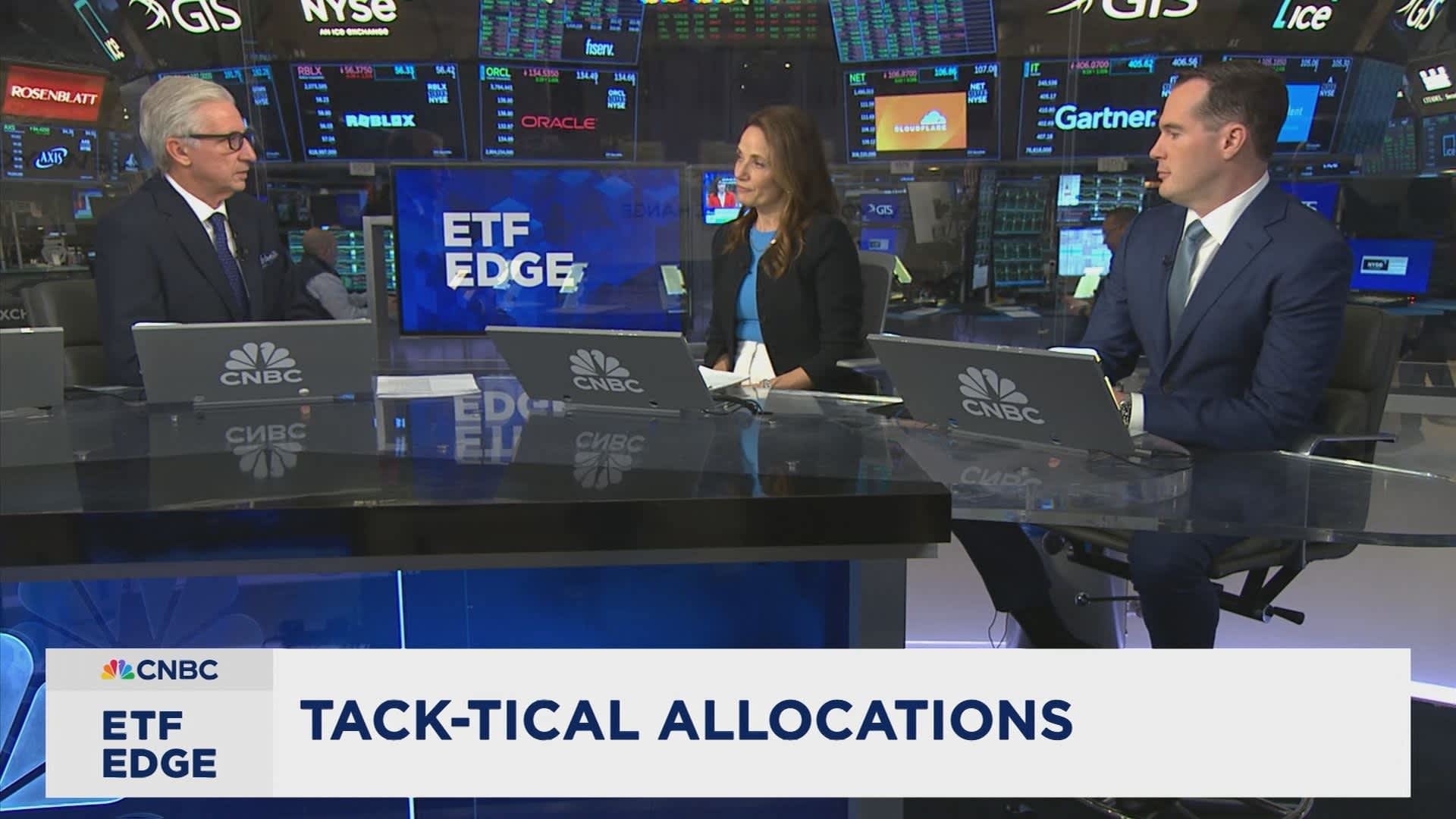
Anna Paglia, State Street Investment Management’s chief business officer, said on CNBC’s “ETF Edge” on Monday that retirement plan markets where ETFs have not to date been represented as core index fund options, including the 401(k) and 403(b) market, are an opportunity she estimated at a size of $4 trillion, and will be a focus.
Some of the benefits of ETFs, such as more efficient tax trading, may not be important to investors in tax-deferred retirement plans. ETFs’ intraday valuation — they trade in real time throughout the day like stocks, as opposed to traditional mutual funds’ once-a-day valuation — has also been an issue for some plan sponsors. But the low fees and massive scale of State Street’s assets under management give it an advantage in offering investors and retirement plan sponsors competitive portfolio offerings.
“We now have $1.7 trillion in ETF assets,” Paglia said, explaining that the company can use its existing scale to create a more competitive offering regardless of share class. “The enemy of efficiency is fragmentation,” Paglia said.
In a Barron’s op-ed recently penned by Paglia to explain the company’s thinking, she noted that while the tax efficiency that attracts many investors to ETFs can’t be replicated in the retirement plan market, what are called the “in-kind flows” used in ETF management can lead to lower costs and better performance over time for retirement investors.
“That is because when large institutions redeem ETF shares, ETFs aren’t forced to sell investments to raise cash like mutual funds. Instead, ETF issuers can transfer securities directly to these large institutions, typically market makers or broker-dealers, through ‘in-kind’ redemptions. By avoiding selling in the open market, this process helps lower turnover and associated trading costs in the underlying portfolio — efficiencies that benefit investors in all share classes,” Paglia wrote.
State Street’s largest ETFs
- SPDR S&P 500 ETF Trust (SPY)
Assets: $698 billion
Expense ratio: 0.0945% - SPDR Gold Shares (GLD)
Assets: $132 billion
Expense ratio: 0.40% - State Street SPDR Portfolio S&P 500 ETF (SPYM)
Assets: $95 billion
Expense ratio: 0.02% - Technology Select Sector SPDR Fund (XLK)
Assets: $95 billion
Expense ratio: 0.08% - Financial Select Sector SPDR Fund (XLF)
Assets: $52 billion
Expense ratio: 0.08%
Source: State Street
The SEC recently began the greenlighting of ETF share classes of traditional mutual funds with an application from Dimensional Fund Advisors. The mutual fund industry is expected to move in droves to adopt this new ETF provision. More than 70 fund providers have applications pending and the ICI, the main fund industry trade group, recently told “ETF Edge” it has been working with hundreds of fund companies to be prepared to take advantage of the SEC exemptive relief.

However, the current government shutdown has put a hold on any further actions, including State Street’s plans for ETFs to be made available as mutual funds in the retirement market. When State Street Investment Management is able to move forward, there will be a question of which ETFs in particular can stand out in the 401(k) market. While greater trading and cost efficiencies can be gained by trading across more than one share class, many core strategies in the ETF lineup are already offered by State Street to retirement investors in traditional fund portfolio shares.
And in an asset management industry where ETFs and index funds from giants like Fidelity Investments and Vanguard Group have pushed fees literally down to zero, economies of scale across portfolios are already critical to competing for investor assets. Fidelity already offers four zero-fee core index mutual funds. The expense ratio on Vanguard’s record-breaking S&P 500 ETF (VOO), which has set an all-time high in annual flows for an ETF, is three basis points (0.03%). State Street’s SPYM, a new version of SPY, has an expense ratio of two basis points (0.02%).
But ETFs have become the go-to way for many investors to access any kind of market strategy, from core equity to thematic equity to ever-narrower slices of the bond market, as well as alternatives including precious metals and crypto.
“Mutual funds are the way for ETF-oriented companies to … meet investors where they are,” said Todd Rosenbluth, head of research at VettaFi, on “ETF Edge.”
He noted that State Street isn’t the only asset manager planning to create mutual fund share classes of ETFs, with F/M Investments planning a similar approach to benefit from the SEC decision.
Making the world’s biggest gold fund more widely available at a potentially lower cost in 401(k) plans comes at a time when many more investors are adding gold as a bigger allocation in a traditional portfolio, often at the expense of bond funds. But given the existing low-cost stock and bond options across the major fund companies and retirement plan providers, Rosenbluth said State Street’s biggest opportunities to stand out in the 401(k) market at an individual portfolio level beyond GLD may be with its Select Sector SPDRs like XLK and XLF, and newer alternative ETFs it has launched like SPDR Bridgewater ALL Weather ETF (ALLW) and SPDR SSGA IG Public & Private Credit ETF (PRIV) that provide retail investors access to portfolio strategies typically only available to institutional investors.
ALLW, a global multi-asset allocation fund, includes billionaire hedge fund manager Ray Dalio’s Bridgewater Associates as a sub-advisor. PRIV was the first ETF with significant private credit exposure approved by the SEC, though not without some controversy.
Paglia described the plans as being less about marketing any particular strategy and more in terms of creating a structure for State Street’s fund business that can bring the best of the ETF structure into more markets. “The ETF technology is the most efficient technology in this market but the ETF technology is not the appropriate wrapper for everybody,” Paglia said on CNBC’s “ETF Edge.”
“In my view, the retirement industry is not benefitting from the innovation that the ETF industry is bringing to the market and is benefiting from,” she added.
To be sure, State Street is already a huge player in the retirement market, third overall in assets under management in “defined contribution investment only” assets (those gathered through other third-party managed retirement platforms). State Street does not have its own defined contribution recordkeeping business similar to those offered by Fidelity, Vanguard, and Empower. But in assets within strategies across retirement plans, State Street is behind only Vanguard and BlackRock (which runs the iShares ETF family), according to Cerulli Associates, with over $800 billion and annual growth of 19% in 2024.
State Street historically has had more collective investment trust offerings than traditional mutual funds for the retirement market, and depending on the ETF strategies they are adapting to mutual funds, there is an opportunity for growth in the small and mid market plan segments, which historically have had limited access to CITs due to their size, according to Cerulli.
The fragmentation Paglia cited stems from the fact that there are many legal wrappers for portfolio strategies used across retirement plans, including collective investment trusts, target date funds, mutual funds, and ETFs.
“My IRA is invested in ETFs, but my 401(k) plan is not,” she said. “It’s not a conversation about ETFs vs. mutual funds,” Paglia said. But she added that with the SEC giving the ability, when the government reopens, to asset managers to have different share classes, State Street can take advantage of the size and scale of its ETF business. “We do have the power of scale,” she said. “We also have the power of content because we have hundreds of strategies. … and once you combine content and cost you have something investors may benefit from in the end.”
Correction: An earlier version of this article included incorrect assets under management data for the top State Street SPDR ETFs due to an editing error.