A customer at a food market in Palma, Mallorca, Spain.
Andrey Rudakov/Bloomberg via Getty Images
As economists ring alarm bells over the impact of President Donald Trump’s tariff policy on consumers and the U.S. economy, there’s a group of Americans who may benefit: tourists traveling abroad.
That’s due to the impact of tariffs on the U.S. dollar and other global currencies. Economists expect tariffs imposed on foreign imports to strengthen the U.S. dollar and potentially weaken major currencies like the euro.
In such a case, travelers would have more buying power overseas in 2025, economists said. Their dollar would stretch further on purchases like lodging, dining out and guided tours that are denominated in the local currency.
“Tariffs, all else equal, are good for the U.S. dollar,” said James Reilly, senior markets economist at Capital Economics.
The U.S. dollar has risen amid tariff threats
The Nominal Broad U.S. Dollar Index in January hit its highest monthly level on record, dating to at least 2006. The index gauges the dollar’s strength against currencies of the U.S.’ main trading partners, like the euro, Canadian dollar and Japanese yen.
Meanwhile, the ICE U.S. Dollar Index (DXY) – another popular measure of the strength of the U.S. dollar – is up more than 3% since Trump’s election day win.
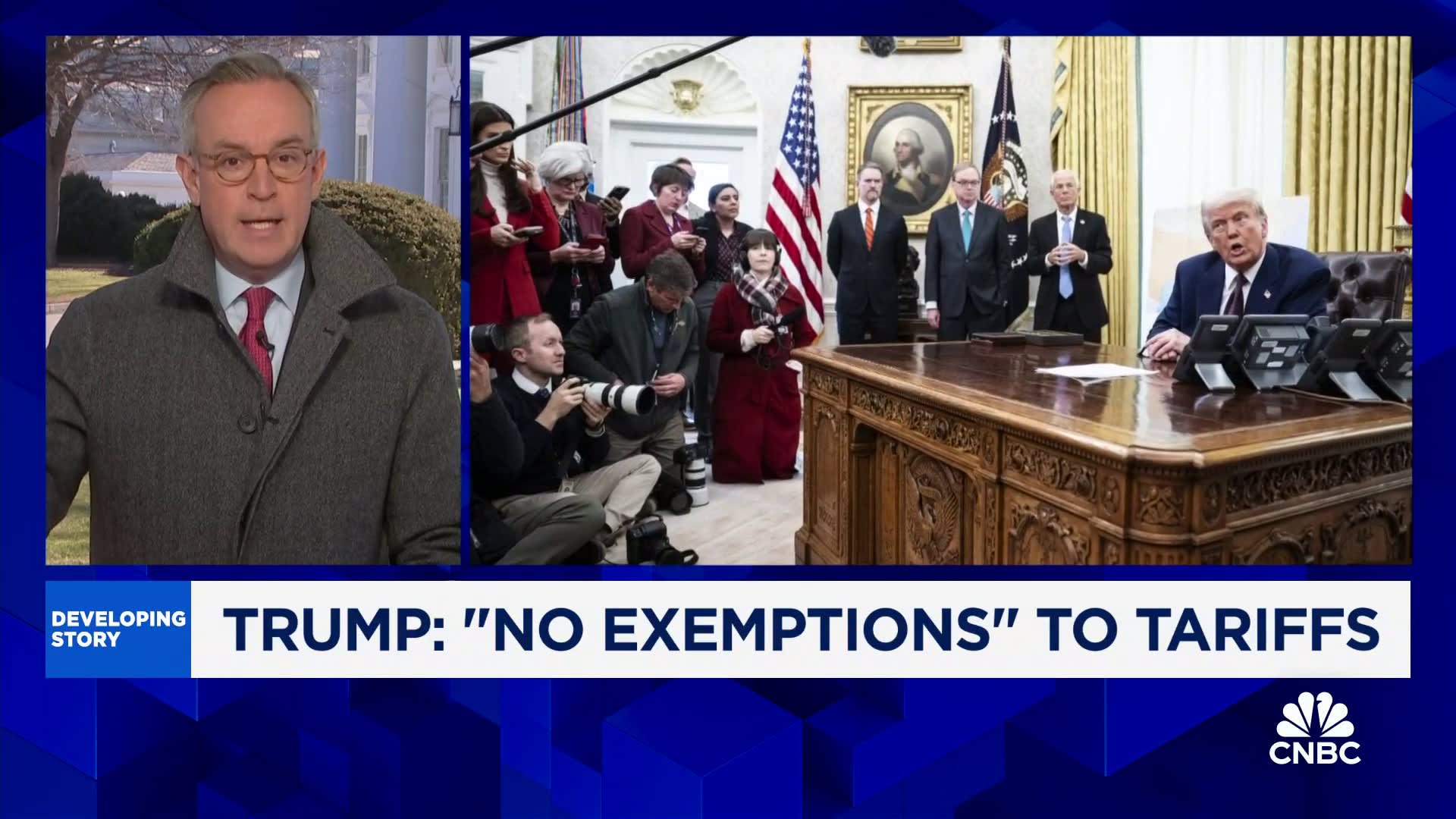
Trump on Thursday laid out a plan to impose retaliatory tariffs against trading partners on a country-by-country basis. Specific levies will depend on the outcome of a Commerce Department review, which officials expect to be completed by April 1.

Meanwhile, Trump has imposed an additional 10% tariff on Chinese goods. A 25% duty on all steel and aluminum imports is set to take effect March 4. Further, a 25% tariff on Canada and Mexico may take force in March, after being paused for 30 days.
The Canadian dollar offers a recent example of the potential impact of a tariff, Reilly said.
On Feb. 4, when the Canadian tariffs were set to take effect, the U.S. dollar spiked to its highest level in at least a decade against the Canadian dollar, before eventually falling back when Trump delayed the duties for a month.
More from Personal Finance:
Here’s the inflation breakdown for January 2025 — in one chart
Wholesale egg prices have ‘blown way past’ record highs
How the U.S. has used tariffs throughout history
A trade war with China in 2018-19 during Trump’s first term also offers insight into the impact of tariffs on currencies, J.P. Morgan global market strategists wrote in October.
The Trump administration raised tariffs on about $370 billion of Chinese goods from an average of 3% to 19% during 2018-19, and China retaliated by raising tariffs on U.S. exports from 7% to 21%, the J.P. Morgan strategists wrote.


While other factors also influenced currency moves, trade policy uncertainty “tended to bolster the dollar,” J.P. Morgan reported. The DXY index rose up to 10% during tariff announcement windows in 2018 and 4% in 2019, they wrote.
Why tariffs are good for the U.S. dollar
Tariffs — even the threat of them — can bolster the dollar relative to other currencies in a few ways, Reilly explained.
One key way is via interest rates — specifically, the differential between one nation’s interest rates and another, he said.
Tariffs are generally viewed as inflationary, since the import duties are expected to raise consumer prices, at least in the short term, economists said.
The Federal Reserve would likely keep interest rates elevated to keep a lid on U.S. inflation, which hasn’t yet fallen back to policymakers’ target level after soaring in the pandemic era.
“We expect the USD [U.S. dollar] to remain strong in the short term, mostly on the back of US inflationary policies and particularly tariffs,” Bank of America currency analysts wrote in a note Friday.
(Their analysis was of “G10” nations: Belgium, Canada, France, Germany, Italy, Japan, The Netherlands, Sweden, Switzerland, the United Kingdom and U.S.)
Based on available information around Trump’s retaliatory tariff plan, the average effective tariff rate on all U.S. imports would rise from less than 3% now to around 20% — which would add about 2% to U.S. consumer prices and temporarily boost inflation to 4% in 2025, Paul Ashworth, chief North America Economist at Capital Economics, estimated Thursday.
On the flip side, other nations’ economies would likely suffer from the U.S. levies, Reilly said.
Take Europe, for example.
Europe might export less to the U.S. as a result, which would negatively impact the European economy, he said. That would make it more likely for the European Central Bank to cut interest rates in order to bolster the economy, Reilly said.
A wider interest-rate differential would result from elevated U.S. interest rates and lower European rates.
Such a dynamic would likely lead investors to move money into U.S. assets — perhaps U.S. Treasury bonds, for example — to seek a higher relative return, causing them to sell euro-denominated assets in favor of dollar-denominated assets, Reilly said.
In this case, higher demand for the U.S. dollar and lower demand for the euro may lead to a stronger dollar, he said.
The euro and British pound sterling are especially sensitive to such interest-rate differentials, while emerging-market currencies are less so, Reilly said.
Will the dollar weaken later in the year?
Of course, there’s considerable uncertainty over how the U.S. would apply tariffs on other nations — and whether levies that have been proposed would even take effect. Retaliatory tariffs from trading partners could blunt a runup in the U.S. dollar, economists said.
The dollar could weaken later in the year if the world retaliates against the U.S. and these trade policies “take a toll on the U.S. economy,” Bank of America analysts wrote.
Indeed, most investors expect the U.S. dollar’s strength to peak in the first or second quarter of 2025 — 45% and 24%, respectively, according to a Bank of America survey conducted from Feb. 7 to Feb. 12. (The poll was of 52 fund managers from the U.K., Continental Europe, Asia and the U.S.)
However, in general, most countries are more dependent on the U.S. than the U.S. is on them for trade, Reilly said.
“So they can’t really retaliate to the same extent the U.S. can,” he said.