President Donald Trump on Jan. 27, 2025 in Doral, Florida.
Joe Raedle | Getty Images News | Getty Images
President Donald Trump has repeatedly discussed imposing tariffs, both during the campaign and since taking office, and the first tranche, on goods from Canada, China and Mexico will take effect Feb. 1, the White House confirmed Friday.
While there are still some unknowns, one thing is clear, economists said: U.S. consumers should brace for a negative financial impact.
It’s “hard to find positives” from tariffs, said Mary Lovely, a senior fellow at the Peterson Institute for International Economics, whose research specializes in trade with China and global supply chains.
Trump plans to put 25% tariffs on Mexico and Canada, and a 10% duty on China, Karoline Leavitt, the White House press secretary, said Friday.
China, Mexico and Canada are the three largest trading partners with the U.S., as measured by imported goods. They supplied about $536 billion, $455 billion, and $437 billion of goods, respectively, to the U.S. in 2022, according to the Office of the U.S. Trade Representative.

Tariffs are a tax on foreign imports. U.S. businesses that import goods pay that tax to the federal government.
Many businesses will funnel those extra costs to customers — either directly or indirectly — which is why tariffs generally trigger higher prices for consumers, economists said.
“Part of these tariffs will be passed on to consumers,” Lovely said.
Americans could also find they have fewer choices for brands and products stocked on store shelves, she said.
Exemptions may ‘limit the damage’ to consumers
There are still many question marks over the looming tariffs on Canada, China and Mexico.
For example, it’s unclear if any imports will be exempt. Trump suggested Thursday night, for example, that Canadian oil might be exempt. The White House said the tariffs will be open for public inspection on Saturday.
Discussions around such specifics are “ongoing,” a White House official told CNBC on Friday morning.
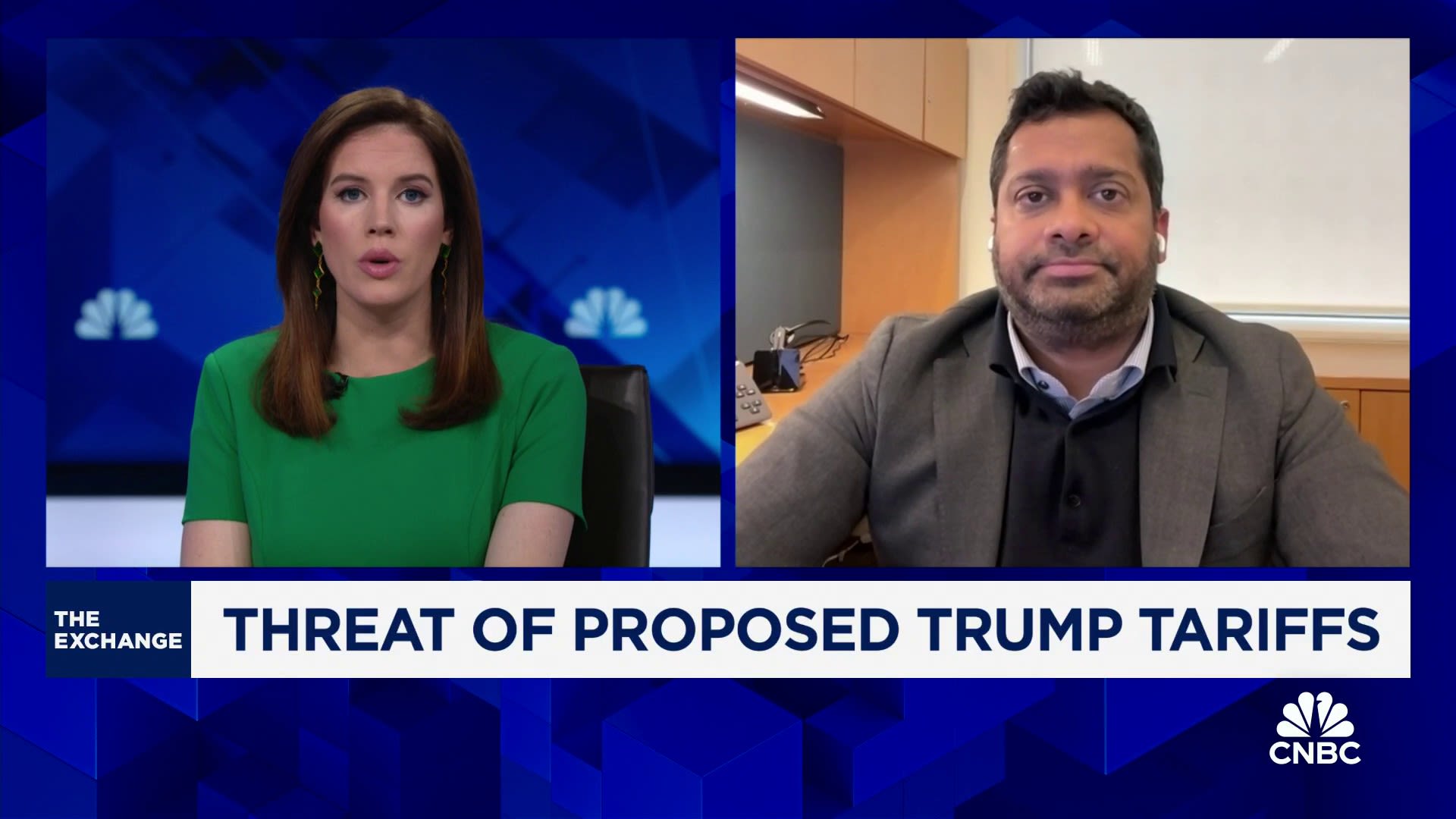
“There are always exemptions and carve-outs,” said Mark Zandi, chief economist at Moody’s.
Trump might try to “limit the damage to the U.S. consumer” via those exemptions, Zandi said. For example, he could choose not to impose duties on apparel from China, avocados from Mexico or cheese from Quebec, he said.
Economic impact
The White House said tariffs and Trump’s broader economic agenda will benefit the U.S. economy.
White House spokesman Kush Desai said tariffs Trump imposed in his first term — along with tax cuts, deregulation and energy policy — “resulted in historic job, wage, and investment growth with no inflation,” and that in his second term Trump will use tariffs to “usher in a new era of growth and prosperity for American industry and workers.”
Economists, however, disagree.


More from Personal Finance:
What federal workers need to consider when evaluating offer to resign
2025 is a ‘renter’s market,’ housing economist says
Concert ticket prices have soared, but music fans don’t seem to care
A 25% Canada-Mexico tariff and 10% China tariff would raise about $1.3 trillion in revenue through 2035 on a net basis, the Committee for a Responsible Federal Budget estimated. That revenue may be used to partially offset the cost of tax cuts, a package that might cost more than $5 trillion over 10 years.
However, a 10% additional tariff on China would shrink the U.S. economy by $55 billion during the Trump administration’s second term, assuming China retaliates with its own tariffs, according to an analysis by Warwick McKibbin and Marcus Noland, economists at the Peterson Institute for International Economics.
A 25% tariff on Mexico and Canada would cause a $200 billion reduction in U.S. gross domestic product, they found.
Meanwhile, economists expect more tariffs in the future.
On the campaign trail, Trump floated a 10% or 20% universal tariff on all imports and a tariff of at least 60% on Chinese goods, for example.
A 20% worldwide tariff and a 60% levy on Chinese goods would raise costs by $3,000 in 2025 for the average U.S. household, according to an October analysis by the Tax Policy Center.
“Broad-based, universal tariffs and the damage they will do is not really a debate,” Zandi said. “They will do damage. It’s just a question of how much and to whom.”
How tariffs may impact consumers
Consumers could pay for tariffs both directly and indirectly, economists said.
Tariffs on China would likely have the largest direct impact on consumers, as the bulk of what China exports to the U.S. is consumer goods such as apparel, toys and electronics, Zandi said.
China is the “dominant supplier” of toys and sports equipment to the U.S., and provides 40% of its footwear imports and 25% of its electronics and textiles, according to a recent analysis by PIIE economists.
Mexico and Canada tariffs would also “put upward pressure on food prices,” according to PIIE economists.
The nations are “important sources” of vegetables, accounting for 47% of total U.S. imports, and prepared foodstuffs, 42%. Transportation equipment and machinery, electronics and fuel are other sectors that stand to be most affected, they found.
“The U.S. imports roughly 40% of its crude oil, with Canada as the dominant supplier,” Nigel Green, CEO of deVere Group, a financial consulting firm, said in a written statement.
“If oil is hit with tariffs, the impact could hit energy markets, pushing up costs for businesses and consumers,” Green wrote.
However, domestic energy producers, certain U.S. manufacturers and other industries “could see short-term gains from reduced competition,” he added.
Indirectly, U.S. producers might raise their prices because they face less foreign competition for certain goods, Lydia Cox, an assistant professor of economics at the University of Wisconsin-Madison, said during a recent webinar.
U.S. companies that use tariffed goods to manufacture their products might also raise prices for downstream goods, Cox said. For example, steel tariffs might lead to higher prices for cars, heavy machinery and other products that use steel.
Tariffs ‘create a lot of collateral damage’
Other nations might also respond with retaliatory tariffs that start a trade war, which might cause U.S. producers to lose sales abroad, she said.
“Unlike Canada and Mexico, for which retaliation would be inconceivable, China has retaliated in the past and would likely do so again,” PIIE economists wrote recently.
Further, tariffs may have the unintended consequence of destroying jobs, economists said.
Tariffs’ ability to create U.S. jobs is “vastly, vastly overstated,” said Lovely of PIIE.
Take steel, for example. There are 80 workers in industries that use steel as an input for every one job that produces steel, Cox found in a recent paper.
Tariffs create “a lot of collateral damage along the way,” which is why economists warn against broad-based use, Cox said.